 Dynamo
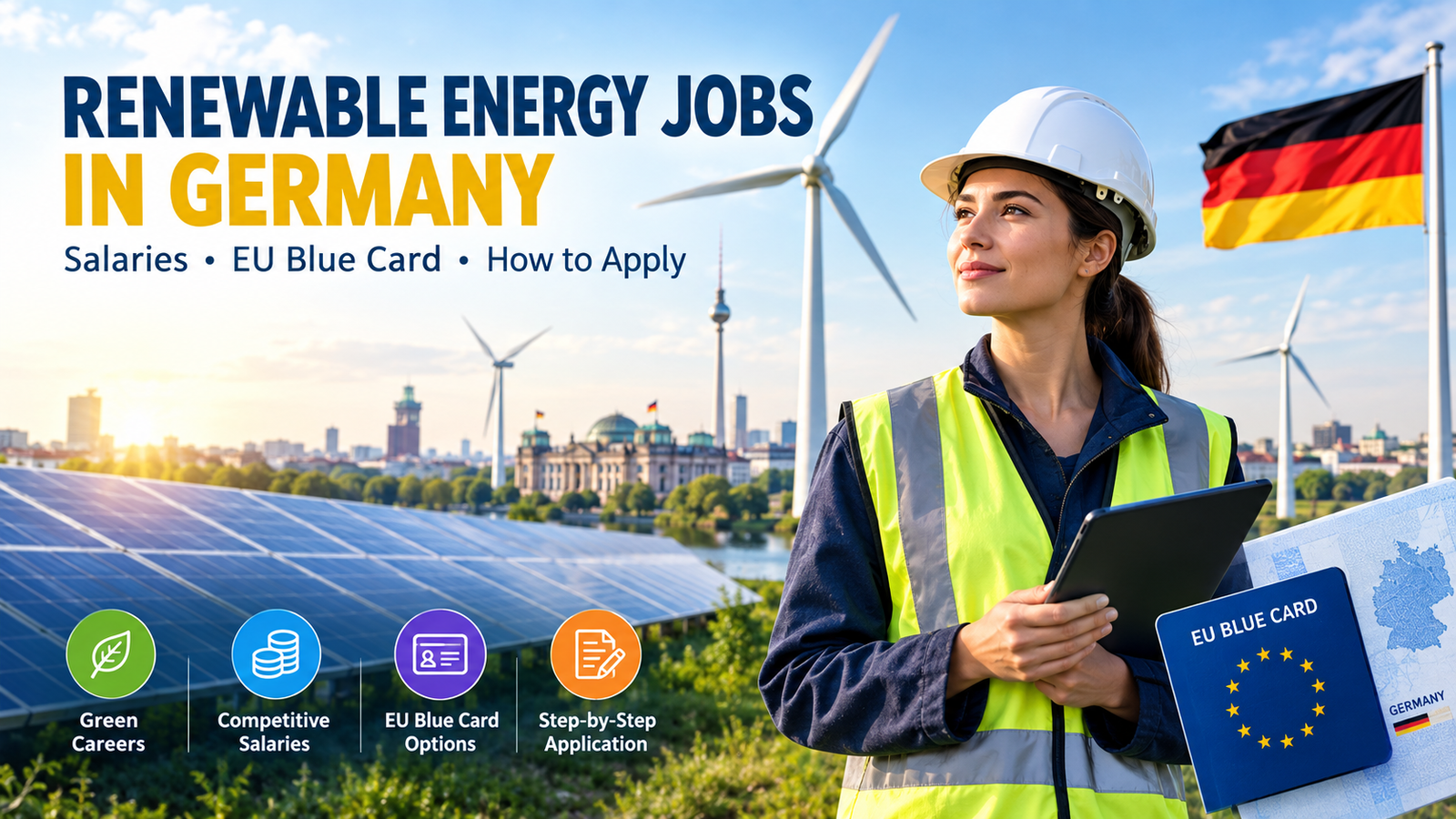
Renewable Energy Jobs in Germany: High-Demand Careers in 2026
“Renewable Energy Jobs in Germany are attracting professionals seeking opportunities in one of Europe’s expanding clean-energy markets.” Germany’s transition toward a lower-carbon economy is creating opportunities for engineers, technicians, project managers, IT specialists, energy consultants and other skilled professionals.
For international workers, this makes Germany particularly interesting because the country has established immigration routes for qualified professionals, including the EU Blue Card, skilled-worker residence permits and other employment-based options.
Germany’s renewable energy sector is also expanding beyond traditional solar and wind power. Opportunities increasingly exist across energy storage, battery technology, hydrogen, grid infrastructure, heat pumps, energy efficiency, environmental engineering and digital energy systems.
According to Germany’s Federal Ministry for Economic Affairs and Energy, an estimated 436,300 people worked in the renewable energy sector in 2025, representing a new employment record. Onshore wind accounted for approximately 131,300 jobs, while solar energy provided around 88,200 and heat pumps approximately 72,200 jobs.
For professionals outside the European Union, however, finding a job is only part of the process. You also need to determine whether your qualifications are acceptable, whether your salary meets the applicable immigration threshold and which German visa or residence permit is appropriate.
This guide explains renewable energy jobs in Germany, expected salaries, EU Blue Card requirements in 2026, qualification recognition and how international applicants can apply.
Renewable Energy Jobs in Germany in 2026
Germany’s renewable energy industry covers much more than installing solar panels or maintaining wind turbines.
The country’s energy transition has created demand across engineering, construction, manufacturing, software, project development, operations, environmental management and technical services.
The official Make it in Germany portal identifies green jobs as an area where international skilled professionals can find opportunities. It specifically highlights engineering and technical occupations connected with energy and electrical engineering, photovoltaics, wind power, environmental engineering, construction and IT.
Common renewable energy careers include:
- Renewable energy engineer
- Energy systems engineer
- Electrical engineer
- Mechanical engineer
- Environmental engineer
- Solar photovoltaic engineer
- Wind energy engineer
- Wind farm manager
- Energy consultant
- Project manager
- Renewable energy project developer
- Grid and power systems specialist
- Battery technology specialist
- Hydrogen technology specialist
- Automation engineer
- Energy data analyst
- Software developer for energy systems
- Solar installation technician
- Wind turbine service technician
- Biogas plant technician
- Energy-efficiency specialist
The exact requirements vary considerably between jobs.
A senior renewable energy engineer may need a university degree and several years of professional experience, while a technical installation or maintenance position may be based primarily on vocational qualifications and practical experience.
Germany’s official employment portal also lists engineers, scientists, IT specialists and skilled craftspeople among occupations where qualified workers are in demand.
High-Demand Renewable Energy Careers for International Professionals
Renewable Energy Engineers
Engineers are central to Germany’s energy transition.
Depending on their specialization, engineers may work on wind farms, photovoltaic systems, electrical grids, battery storage, hydrogen infrastructure, energy efficiency or industrial decarbonisation.
Germany’s official skilled-worker portal reports that renewable energies and environmental protection are among the areas offering career opportunities for engineers. It also reported approximately 76,000 unfilled vacancies in the broader engineering sector in 2025.
Solar Energy Professionals
Germany has one of Europe’s largest solar markets, creating opportunities in areas such as:
- Photovoltaic system design
- Solar project development
- Electrical engineering
- Installation
- Operations and maintenance
- Energy storage
- Technical sales
- Project management
Professionals with electrical engineering, energy technology or construction-related experience may find solar-sector roles particularly relevant.
Wind Energy Jobs
Wind power is another major source of employment.
Career opportunities range from engineering and project development to turbine maintenance, environmental assessment, construction management and operations.
The 2026 figures published by Germany’s Federal Ministry for Economic Affairs and Energy show that onshore wind was the largest renewable-energy employer in 2025, with approximately 131,300 jobs. Offshore wind accounted for around 41,000 jobs.
Battery, Hydrogen and Energy Storage Careers
Germany’s energy transition is also creating opportunities outside conventional renewable generation.
Professionals working in battery technology, hydrogen systems, power electronics, energy storage, automation and energy management can find positions connected with the broader transformation of the energy system.
The Federal Employment Agency’s salary database, for example, groups energy engineering, battery engineering and hydrogen technology management within its energy and power-plant engineering occupational category.
Renewable Energy IT and Data Jobs
Digitalisation is becoming increasingly important in the energy sector.
Renewable energy companies need software developers, data analysts, automation specialists, cybersecurity professionals and other technology workers to manage increasingly complex energy systems.
This means an international IT professional does not necessarily need to work directly with turbines or solar panels to participate in Germany’s renewable energy economy.
Renewable Energy Jobs in Germany: Salary Expectations in 2026
Salary is one of the most important considerations for international professionals comparing job opportunities in Germany.
Actual compensation depends on occupation, qualifications, experience, employer, location, industry segment and seniority.
The Federal Employment Agency’s Entgeltatlas provides official salary statistics for different occupations.
For the occupational category covering highly complex work in renewable energy technology, the Entgeltatlas currently reports a median gross monthly full-time salary of €6,034 for the occupation group that includes renewable energy engineers and wind farm managers. The lower quartile is €4,968 and the upper quartile is €7,426.
For the broader occupational category covering highly complex energy and power-plant engineering work, the reported median is €7,183 gross per month. This category includes energy engineers, battery engineers and hydrogen technology managers.
A technical renewable-energy position can have a different salary profile. For example, the Entgeltatlas reports a median gross monthly salary of €3,967 for the occupational category covering service technicians for biogas plants and related renewable-energy technical occupations.
Renewable Energy Salary Examples
| Career area | Example gross monthly median |
|---|---|
| Renewable energy engineer / wind farm manager category | €6,034 |
| Energy engineering / battery / hydrogen technology category | €7,183 |
| Renewable energy technical/service category | €3,967 |
These figures should be treated as salary reference points rather than guaranteed salaries. They are based on occupational categories and German employment statistics, and an individual job offer can be substantially different.
Gross salary is also different from take-home pay because German income tax and social-insurance contributions affect net income.
For immigration purposes, another figure matters: the salary written into your employment contract must satisfy the requirements of the residence route you are applying for.
EU Blue Card Germany 2026: Salary Requirements
The EU Blue Card is one of the most important immigration routes for highly qualified non-EU professionals who have a qualifying job offer in Germany.
For 2026, Germany’s official Make it in Germany portal states that the standard EU Blue Card salary threshold is €50,700 gross per year.
That works out to:
€50,700 ÷ 12 = €4,225 gross per month
However, a lower salary threshold can apply to certain shortage occupations and certain recent graduates.
For 2026, the lower EU Blue Card threshold is €45,934.20 gross per year, provided the applicable conditions are met. The official German government portal identifies academic STEM occupations among the shortage occupations relevant to the reduced threshold.
That equals approximately:
€45,934.20 ÷ 12 = €3,827.85 gross per month
This distinction is particularly relevant to renewable energy professionals because many engineering and technical positions fall within STEM-related fields.
However, do not automatically assume that every renewable-energy job qualifies for the reduced Blue Card salary threshold.
The immigration authority considers the occupation and the specific circumstances of the application.
EU Blue Card Requirements for Renewable Energy Professionals
Meeting the salary threshold is only one part of the application.
According to the official German government information, applicants generally need a recognised or comparable higher-education qualification and a specific employment offer in Germany.
For the standard EU Blue Card route, the employment relationship must generally last at least six months and the job must correspond to the applicant’s qualification.
The main requirements can therefore be summarised as follows.
1. A qualifying higher-education qualification
You generally need a German higher-education qualification or a foreign qualification comparable to a German one.
Germany uses the anabin database as one way to establish comparability.
If your university is listed as recognised and your degree is assessed as corresponding or equivalent, the relevant anabin documentation can be used as evidence.
If your university or degree is not sufficiently covered by anabin, you may need a Statement of Comparability from Germany’s Central Office for Foreign Education, known as ZAB.
2. A qualifying job offer
You need a specific employment offer from a German employer.
The position should correspond to your qualification and meet the applicable requirements for the EU Blue Card.
For regulated professions, such as certain healthcare occupations, additional professional licensing requirements may apply.
3. The required salary
For 2026, the standard threshold is €50,700 gross per year.
A reduced threshold of €45,934.20 may apply to qualifying shortage occupations and certain new entrants to the labour market.
4. Additional immigration requirements
Depending on your circumstances, the German authorities may require supporting documentation relating to your employment, qualifications, identity and other legal requirements.
Because immigration rules can change, applicants should verify their individual circumstances through the official German government immigration sources before submitting an application.
Does Renewable Energy Qualify for the EU Blue Card?
There is an important distinction between working in renewable energy and automatically qualifying for a particular immigration category.
A renewable energy job does not receive an EU Blue Card simply because it is environmentally focused.
Instead, the position and applicant must satisfy the relevant legal requirements.
For example, an appropriately qualified renewable energy engineer with a German job offer and a salary above the applicable threshold may potentially qualify.
A renewable-energy technician earning below the applicable Blue Card threshold may need to investigate another residence route instead.
This is why international applicants should assess:
- Their occupation
- Their educational qualification
- Their qualification comparability
- Their employment contract
- Their annual gross salary
- Whether their occupation falls within a relevant shortage category
- Whether a different skilled-worker visa is more appropriate
How to Check Whether Your Foreign Degree Is Accepted in Germany
Before spending significant time on job applications, check your academic credentials.
The German government recommends using anabin to establish whether a foreign university and qualification are comparable to German standards.
For a positive anabin result, the relevant university and degree information must satisfy the applicable requirements.
If anabin does not provide sufficient evidence, you can apply for a Statement of Comparability through ZAB.
This step can be particularly important for applicants from outside the European Union.
Do not assume that having a bachelor’s or master’s degree automatically means the qualification will be accepted for immigration purposes.
What If My Qualification Is Not Recognised?
The correct route depends on your profession and the visa category.
Germany distinguishes between regulated and non-regulated occupations.
For non-regulated academic occupations, formal professional recognition may not be required in the same way it is for regulated professions. However, applicants using the EU Blue Card or certain skilled-worker routes still need to provide evidence that their foreign degree is comparable to a German qualification.
How to Find Renewable Energy Jobs in Germany
A successful German job search should combine specialised job boards, company career pages and official employment resources.
One useful starting point is the official Make it in Germany job exchange, which provides job listings across multiple sectors and regions.
Search using specific professional keywords rather than only the phrase “renewable energy jobs.”
For example, try:
- Renewable Energy Engineer
- Energy Engineer
- Electrical Engineer
- Wind Energy Engineer
- Solar Engineer
- Photovoltaic Engineer
- Energy Consultant
- Project Engineer
- Project Manager Renewable Energy
- Wind Farm Manager
- Energy Systems Engineer
- Hydrogen Engineer
- Battery Engineer
- Environmental Engineer
- Energy Data Analyst
- Solar Technician
- Wind Turbine Technician
German search terms can also expand your results:
- Erneuerbare Energien
- Energietechnik
- Elektroingenieur
- Windenergie
- Photovoltaik
- Solarenergie
- Wasserstoff
- Energiespeicher
- Energieberater
How to Apply for Renewable Energy Jobs in Germany
Step 1: Identify your target occupation
Start with your actual qualifications and professional experience.
For example, an electrical engineer might target:
- Grid engineering
- Solar PV
- Wind power
- Energy storage
- Power electronics
- Industrial energy systems
Avoid applying randomly to jobs simply because they contain the word “renewable.”
Your qualification should make sense for the position.
Step 2: Prepare a German-style CV
Your CV should clearly show:
- Education
- Technical qualifications
- Professional experience
- Software skills
- Engineering tools
- Languages
- Certifications
- Major projects
- Professional achievements
Keep the document easy to scan.
Where possible, quantify achievements.
Instead of writing:
Worked on solar projects.
A stronger description might explain the size, technical scope or responsibility involved.
For example:
Supported the electrical design and commissioning of commercial photovoltaic installations.
Only include claims that accurately reflect your experience.
Step 3: Prepare a professional cover letter
A targeted cover letter can explain why your background matches the specific vacancy.
Avoid sending exactly the same generic letter to every employer.
Focus on:
- Your technical background
- Relevant industry experience
- The company’s project or technology
- Your ability to contribute
- Your language skills
- Your availability
Step 4: Verify your qualification
Check anabin and determine whether you need a Statement of Comparability.
Doing this early can reduce delays later.
Step 5: Apply directly to employers
Look at companies involved in:
- Wind power
- Solar energy
- Energy storage
- Hydrogen
- Grid infrastructure
- Energy consulting
- Engineering
- Energy efficiency
- Environmental technology
Use official company career pages alongside established job portals.
Step 6: Ask the employer about immigration support
If you are applying from outside the EU, make your immigration situation clear when appropriate.
Some employers have experience recruiting international professionals and may be familiar with the EU Blue Card process.
Step 7: Review the employment contract
Before beginning the immigration process, carefully check:
- Job title
- Job description
- Contract duration
- Gross annual salary
- Working hours
- Start date
- Employer information
- Location
The salary stated in the employment contract is particularly important for an EU Blue Card application.
Germany Work Visa Application: How to Apply in 2026
For many non-EU citizens, employment in Germany requires a residence title.
The Federal Foreign Office explains that third-country nationals generally need a residence title to take up employment and, as a general rule, must apply for the relevant visa through the competent German mission before entering Germany. Certain nationalities have special rules allowing them to apply after arrival.
Germany introduced its Consular Services Portal in 2026, allowing eligible applicants to submit applications online for employment, study, vocational training and family-reunification visas.
Typical application process
1. Secure a job offer
Obtain a formal offer or employment contract from a German employer.
2. Check your immigration route
Determine whether the EU Blue Card or another skilled-worker residence route applies.
3. Check your qualification
Use anabin or obtain the appropriate ZAB documentation where necessary.
4. Prepare your documents
Documents can include:
- Valid passport
- Employment contract or job offer
- Academic qualification
- Evidence of qualification comparability
- CV
- Proof of professional experience where relevant
- Completed visa application
- Passport photographs
- Other documents requested by the responsible German mission
Exact requirements vary according to nationality and visa category.
5. Submit the application
Use the German Consular Services Portal where available or follow the instructions of the responsible German embassy or consulate.
6. Attend the required appointment
Even with online applications, the Federal Foreign Office states that an in-person appointment remains necessary for matters such as biometric data, original-document checks and payment of the visa fee.
7. Wait for processing
Processing times vary according to the visa category, location, workload and individual case.
8. Enter Germany and complete the residence process
Once your visa is issued and you enter Germany, follow the instructions applicable to your residence permit.
Official Germany Immigration Source for Applicants
For immigration information, use government sources rather than relying solely on social-media posts, recruitment advertisements or unofficial visa websites.
The most relevant starting point is the German government’s Make it in Germany portal.
Official EU Blue Card information — Make it in Germany
For visa applications and consular procedures, use the German Federal Foreign Office.
German Consular Services Portal — Federal Foreign Office
You can also consult the Federal Foreign Office’s general visa information.
Visas for Germany — Federal Foreign Office
These official resources should be checked again immediately before submitting an application because immigration procedures, fees and thresholds can change.
Renewable Energy Jobs in Germany Without an EU Blue Card
Not every international renewable energy professional needs an EU Blue Card.
Germany has several immigration pathways for skilled workers.
For example, the country’s Skilled Immigration Act expanded routes for qualified workers and introduced or expanded pathways beyond the traditional academic-worker model.
Depending on your circumstances, alternatives may include:
- Residence permit for qualified professionals
- Employment routes for certain professionally experienced workers
- Opportunity Card for eligible jobseekers
- Recognition-related residence routes
- Other employment-based residence permits
The appropriate route depends on your qualifications, job, experience, nationality and personal circumstances.
Therefore, failing to meet the EU Blue Card salary threshold does not necessarily mean that you cannot work in Germany.
It simply means you should investigate whether another legal pathway applies.
Do You Need to Speak German to Get a Renewable Energy Job?
German-language requirements vary by employer and position.
International companies may advertise roles where English is the main working language, particularly in engineering, research, software, project management and multinational corporate environments.
However, German can expand your employment options.
It may be particularly useful for:
- Field engineering
- Construction
- Installation
- Maintenance
- Safety-related work
- Customer-facing positions
- Local project management
- Skilled trades
German language ability can also make everyday life and workplace communication easier.
Applicants should therefore treat language skills as a career advantage rather than assuming that every renewable energy position has the same language requirement.
What Makes a Renewable Energy Job Application Strong?
A strong application is usually specific rather than generic.
Employers may look for evidence of:
Relevant technical skills
Depending on the role, this could include:
- AutoCAD
- PVsyst
- MATLAB
- Python
- SCADA
- Power systems analysis
- Electrical design
- Energy modelling
- Project management
- Data analysis
- CAD
- GIS
- Battery management systems
Only list technologies you genuinely understand.
Relevant project experience
Describe projects using measurable information where possible.
For example:
- Project capacity
- Budget responsibility
- Team size
- Number of installations
- Commissioning responsibilities
- Efficiency improvements
- Timeline
- Geographic scope
Industry knowledge
Demonstrate that you understand the position.
For example, a solar engineer should be familiar with relevant PV system concepts rather than simply describing themselves as “passionate about renewable energy.”
International communication skills
Germany’s renewable energy industry includes multinational organisations and cross-border supply chains.
English can therefore be valuable, while German proficiency may expand opportunities depending on the position.
Renewable Energy Jobs in Germany: Important Mistakes to Avoid
Do not pay someone for a guaranteed German job
Legitimate employers generally recruit based on qualifications and employment requirements.
Be cautious about anyone promising a guaranteed job or guaranteed visa in exchange for large upfront payments.
Do not falsify qualifications
Immigration applications and employment applications require accurate information.
Never alter academic records, employment history or professional certifications.
Do not assume every renewable job qualifies for a Blue Card
The occupation, qualification and salary all matter.
Do not rely on outdated salary figures
The EU Blue Card salary thresholds can change.
For 2026, use the current government figures rather than an older article quoting previous thresholds. Germany’s official portal currently lists €50,700 for the standard threshold and €45,934.20 for applicable shortage occupations and new entrants.
Do not confuse gross and net salary
Immigration salary thresholds are expressed in gross annual income.
A salary of €50,700 gross does not mean that you will receive €50,700 in your bank account.
Do not use unofficial visa websites as your primary authority
Visa information can become outdated quickly.
Always verify immigration requirements through the German Federal Foreign Office and the official Make it in Germany portal.
Renewable Energy Careers in Germany: 2026 Outlook
Germany’s renewable energy industry is supported by the country’s broader energy transition.
The latest figures published by the Federal Ministry for Economic Affairs and Energy indicate that renewable-energy employment reached approximately 436,300 people in 2025, the highest level reported in the cited study.
The employment landscape is spread across several technologies.
In 2025, the reported employment estimates included approximately:
- 131,300 jobs in onshore wind
- 88,200 jobs in solar
- 96,800 jobs in biomass
- 72,200 jobs associated with heat pumps
- 41,000 jobs in offshore wind
- 5,500 jobs in hydropower
- 1,300 jobs in deep geothermal energy
These figures illustrate the breadth of the industry.
They also show why applicants should look beyond a single job title. Renewable energy is an ecosystem involving engineering, manufacturing, construction, software, project development, maintenance, consulting and energy infrastructure.
Frequently Asked Questions About Renewable Energy Jobs in Germany
What is the EU Blue Card salary threshold in Germany in 2026?
The standard EU Blue Card salary threshold is €50,700 gross per year in 2026. A lower threshold of €45,934.20 applies in qualifying shortage occupations and to certain new entrants to the labour market.
Can renewable energy engineers apply for the EU Blue Card?
Potentially, yes. A renewable energy engineer may qualify if the individual and employment meet the EU Blue Card requirements, including the applicable qualification, job and salary conditions.
Is renewable energy a shortage occupation in Germany?
Certain STEM occupations are included among Germany’s shortage occupations for EU Blue Card purposes. Whether a particular renewable-energy position qualifies depends on its classification and the circumstances of the application.
How much do renewable energy engineers earn in Germany?
The Federal Employment Agency’s Entgeltatlas currently reports a median gross monthly salary of €6,034 for the occupational category covering renewable energy engineers and wind farm managers.
Can I work in Germany without speaking German?
Some positions, particularly in international companies, may operate primarily in English. However, German-language ability can broaden employment opportunities, particularly in field-based and customer-facing positions.
Do I need to have my foreign degree recognised?
For non-regulated academic occupations, formal professional recognition is not always required. However, applicants for an EU Blue Card generally need evidence that their foreign degree is comparable to a German higher-education qualification. This can be established through anabin or, where necessary, a Statement of Comparability.
Can I apply for a German work visa online?
The German Federal Foreign Office launched its Consular Services Portal in 2026, enabling eligible applicants to apply online for employment visas and other visa categories. An in-person appointment may still be required for biometrics, document verification and payment.
Where should I check official German immigration requirements?
Start with the German government’s Make it in Germany portal and the Federal Foreign Office. These are the appropriate sources for current visa, residence and employment information.
Final Checklist for International Renewable Energy Job Seekers
Before submitting your application, check the following:
Career
- Your target job matches your qualifications
- Your CV highlights relevant technical experience
- Your professional certifications are clearly listed
- Your language skills are accurately stated
- You have researched the employer
Qualification
- Your university is checked in anabin where applicable
- Your degree comparability evidence is available
- You know whether your profession is regulated
- You have obtained additional recognition if required
Salary
- Your gross annual salary is clearly stated
- You have checked the applicable 2026 EU Blue Card threshold
- You have confirmed whether the shortage-occupation threshold applies
Immigration
- You have identified the correct residence route
- You have checked whether you need a visa before travelling
- You have prepared the required documentation
- You are using official German government sources
- You have checked the current requirements immediately before applying
Conclusion
Renewable energy jobs in Germany offer opportunities across engineering, solar, wind, energy storage, hydrogen, environmental technology, IT and technical services.
The sector is significant enough to support hundreds of thousands of jobs, with Germany’s Federal Ministry for Economic Affairs and Energy reporting approximately 436,300 renewable-energy jobs in 2025.
For international professionals, the EU Blue Card can be an important pathway when the applicant has the appropriate qualification, a qualifying German employment contract and sufficient salary.
In 2026, the standard EU Blue Card salary threshold is €50,700 gross annually, while the lower threshold of €45,934.20 can apply to qualifying shortage occupations and certain recent graduates.
The most practical approach is to work through the process in order:
Find the right occupation → secure a suitable German job offer → verify your qualification → check the salary threshold → choose the correct immigration route → submit the visa application through the appropriate official channel.
Because immigration rules and salary thresholds can change, prospective applicants should always verify the latest requirements with the German government before making financial or relocation decisions.
Official Resources
- Make it in Germany — EU Blue Card
- Make it in Germany — Green Jobs
- Federal Foreign Office — Consular Services Portal
- Federal Foreign Office — Visas for Germany
- Federal Employment Agency — Entgeltatlas
Author Box
About the Author
Dynamo Gills
Writer & Researcher at Biodynasty
Dynamo Gills is a writer and researcher covering international careers, education, immigration pathways and employment opportunities. His work focuses on turning complex information into practical, reader-friendly guides while directing readers toward authoritative sources for important decisions.

 Dynamo