 Dynamo
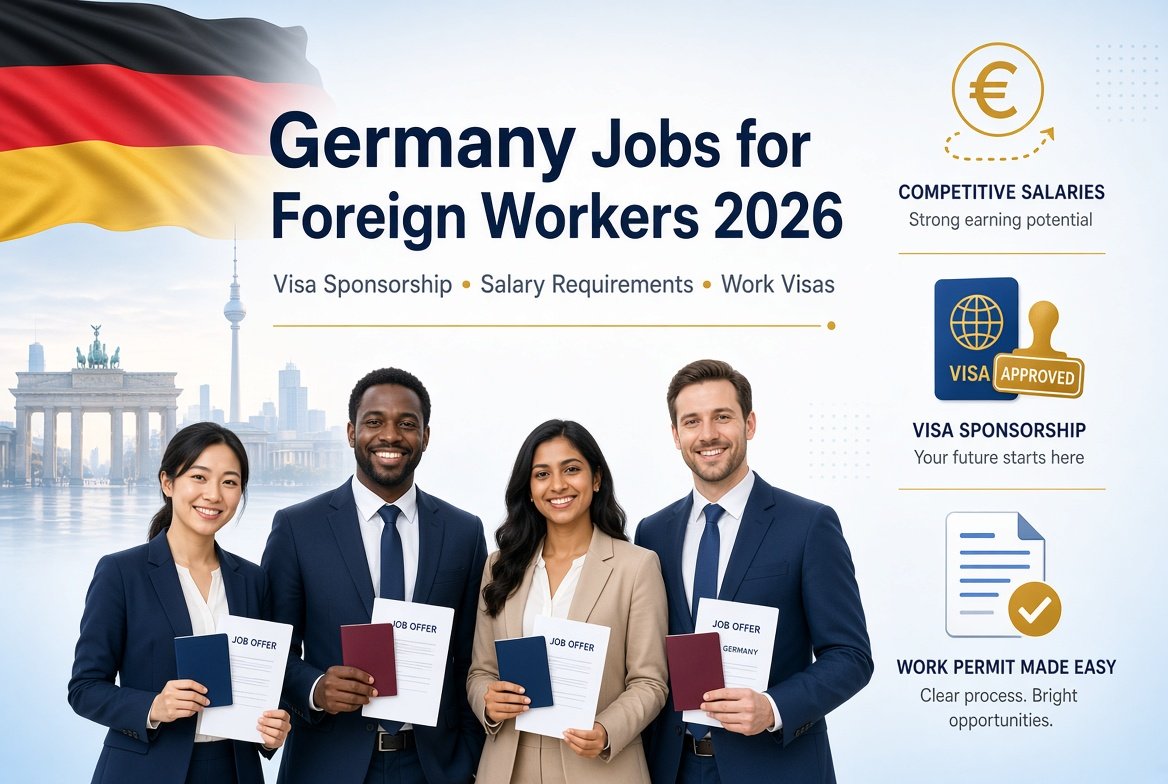
Explore Germany jobs for foreign workers in 2026, including salary requirements, visa sponsorship, EU Blue Card options, work visas and official application resources.
Germany jobs for foreign workers in 2026 are attracting international professionals seeking career opportunities, competitive salaries and legal work authorization. Germany offers several employment-based immigration routes, but eligibility depends on your qualifications, job offer, salary and applicable visa requirements. This guide explains salary requirements, visa sponsorship and work visa options to help you understand the process of working in Germany.
Germany continues to attract international professionals seeking employment in technology, engineering, healthcare, manufacturing, logistics, and other skilled industries. For people living outside the European Union, securing a job is only one part of the relocation process. Applicants must also identify the appropriate work visa, understand salary requirements, verify qualifications, and prepare the documentation required by German immigration authorities.
In 2026, Germany offers several immigration routes for qualified workers, including the EU Blue Card, skilled worker residence permits, and pathways for professionals with relevant work experience. The correct route depends on factors such as your qualifications, job offer, professional experience, salary, and whether your occupation is regulated.
This guide explains how to approach Germany jobs for foreign workers, what employers may offer in terms of visa support, and how to verify your eligibility through official government resources.
Important: This article is educational and not legal or immigration advice. Requirements can depend on your nationality, occupation, age, and individual circumstances. Confirm your eligibility with German government sources or the responsible German mission before paying fees or making relocation commitments.
Table of Contents
- Why Germany Attracts Foreign Workers
- High-Demand Career Areas in Germany
- Germany Salary Requirements for Foreign Workers
- Visa Sponsorship in Germany: What It Means
- Main Work Visa Options in 2026
- EU Blue Card Salary Thresholds
- How to Find Jobs With Employer Support
- Application Process for International Workers
- Costs, Qualifications and Common Mistakes
- Frequently Asked Questions
- Conclusion
Why Germany Attracts Foreign Workers
Germany has a large industrial and service economy, with employers operating in engineering, information technology, healthcare, research, manufacturing, and other professional fields. International recruitment can provide opportunities for people whose skills match employer requirements.
However, a job advertisement that welcomes international applicants does not automatically guarantee visa approval. The employer’s willingness to hire a foreign worker and the applicant’s legal eligibility are separate considerations.
Key factors to evaluate before applying
- Whether your profession is in demand.
- Whether your qualifications meet the requirements for the intended position.
- Whether the employer hires candidates from outside the EU.
- Whether the offered salary meets the relevant immigration threshold, if one applies.
- Whether professional registration or recognition is required.
- Whether the company provides practical assistance with relocation or immigration paperwork.
For official guidance, start with the Make it in Germany portal , which is operated on behalf of the German Federal Government and provides information for international skilled workers.
High-Demand Career Areas in Germany
The availability of jobs changes across industries and regions. Rather than treating every occupation as eligible for the same visa, applicants should compare the specific job requirements with the relevant immigration pathway.

1. Information Technology and Software Engineering
Technology-related roles can include software development, cloud engineering, cybersecurity, data engineering, and IT infrastructure. Some experienced IT professionals may qualify for specific immigration routes even without a conventional university degree, subject to applicable requirements.

2. Engineering and Manufacturing
Mechanical, electrical, industrial, and automation engineering roles may be relevant to applicants with technical qualifications and industry experience. The exact position, qualification requirements, and employer’s recruitment needs matter.

3. Healthcare and Nursing
Healthcare recruitment can involve nurses, physicians, and other professionals. Regulated occupations generally require the necessary professional authorization or recognition, and language requirements may apply.

4. Logistics and Technical Operations
Opportunities may exist in supply chain, logistics management, production, and related technical functions. Applicants must check whether their actual role fits the requirements of the relevant visa category.
Why occupation matters for immigration
Germany’s EU Blue Card system distinguishes between standard salary requirements and lower thresholds for certain shortage occupations and qualifying new graduates. The list of eligible shortage occupations is not a general promise of employment, so candidates should verify their occupation using the current official criteria.
The official EU Blue Card information explains the qualification and employment conditions.
Germany Salary Requirements for Foreign Workers
Salary is one of the most important considerations when evaluating Germany jobs for foreign workers. However, there is no single salary threshold that applies to every German work visa.
The applicable amount depends on the immigration category. Some routes have a specified minimum salary, while others use qualification, employment, age, or collective-agreement conditions.
2026 salary figures to know
The following figures are specifically relevant to routes covered by the official government guidance.
| Immigration route | 2026 salary information |
|---|---|
| Regular EU Blue Card | €50,700 gross annually |
| EU Blue Card for qualifying shortage occupations and eligible new entrants | €45,934.20 gross annually |
| Visa for professionally experienced workers | €45,630 gross annually, subject to route conditions |
| Skilled workers aged over 45 in specified circumstances | €55,770 gross annually or adequate pension provision, depending on the applicable route |
Sources: Make it in Germany – EU Blue Card and professionally experienced workers .
These amounts should not be presented as a universal minimum wage for all foreign workers. The immigration category and the applicant’s circumstances determine which requirement applies.
Gross salary versus net salary
German immigration salary thresholds generally refer to gross annual salary, meaning the amount before taxes and employee deductions.
For example:
- €50,700 gross per year equals €4,225 gross per month when divided across 12 months.
- €45,934.20 gross per year equals €3,827.85 gross per month when divided across 12 months.
These monthly figures are simple annual-to-monthly conversions, not estimates of take-home pay. Net income depends on tax class, social insurance contributions, and other personal circumstances.
Why advertised salary matters
When reviewing an employment contract, pay attention to:
- Annual gross salary.
- Contract duration.
- Working hours.
- Job description and qualification requirements.
- Bonuses and other compensation.
- Whether the position falls within the appropriate visa category.
Do not rely on an advertised salary range alone. Request a formal offer and verify the conditions relevant to your visa application.
Visa Sponsorship in Germany: What It Means
Visa sponsorship is a phrase commonly used in international recruitment, but its meaning varies by country and employer.
In Germany, an employer may support a foreign worker by providing a job offer, employment contract, required employment information, and documentation needed for the immigration process. The employer’s involvement does not mean the applicant automatically receives a visa.
The German authorities assess the applicant’s eligibility under the relevant immigration rules.
What employer support may include
Depending on the company and position, support can involve:
- Issuing a signed employment contract.
- Providing an employer declaration or employment details.
- Assisting with qualification and onboarding documentation.
- Helping the employee understand the visa process.
- Supporting relocation arrangements, where offered by the employer.
For professionally experienced workers, the official guidance states that an employer’s Declaration of Employment will usually be required. The Federal Employment Agency may assess employment conditions, including salary and working hours. See the official route guidance .
What employers do not guarantee
A company cannot be assumed to guarantee:
- Visa approval.
- A particular processing time.
- Permanent residence.
- A specific tax outcome.
- Guaranteed employment after arrival if the contract ends.
Applicants should be cautious about recruiters who request large upfront payments in exchange for a guaranteed job or visa. Verify the employer, job offer, and official application process before transferring money.
Main Work Visa Options in 2026
Germany offers different residence and visa routes for third-country nationals. The following options can help readers identify the appropriate starting point.
1. EU Blue Card
The EU Blue Card is intended for qualified professionals who meet the required conditions, including a qualifying employment offer and salary threshold.
In 2026, the regular annual gross salary requirement is €50,700. A lower threshold of €45,934.20 may apply to eligible shortage occupations and qualifying new entrants, subject to the applicable conditions and any required approval.
The official source is the EU Blue Card information page .
2. Skilled Worker Visa for Qualified Professionals
Germany also provides residence routes for skilled workers with academic or vocational qualifications.
The official guidance for qualified professionals states that applicants generally need a specific job offer for qualified employment. The requirements differ from the EU Blue Card and should be evaluated separately.
Read the official qualified professionals guidance .
3. Visa for Professionally Experienced Workers
Some applicants may qualify through relevant professional experience and a job offer that meets the applicable conditions.
The official 2026 guidance identifies a minimum gross annual salary of €45,630 for this route, unless an applicable collective agreement condition is used. Additional requirements include qualification and experience conditions, and Federal Employment Agency approval may be relevant.
Visit the official professionally experienced worker visa page .
4. Job-Seeking Routes
Applicants who do not yet have a German job offer may need to examine whether a job-search route is appropriate for their circumstances. The Opportunity Card is one pathway covered by Germany’s skilled immigration information.
Eligibility, proof of funds, qualifications, and permitted work activities must be checked before applying. A job-search route should not be confused with a work visa that authorizes full employment from the outset.
The official Make it in Germany visa overview is a useful place to compare routes.
EU Blue Card Salary Thresholds in 2026
The EU Blue Card is one of the most commercially relevant immigration topics for readers searching for professional opportunities in Germany. It connects qualified employment with a specific residence permit and salary requirements.
According to the official German government information for 2026:
| Category | Minimum gross annual salary |
|---|---|
| Standard EU Blue Card | €50,700 |
| Eligible shortage occupations and qualifying new entrants | €45,934.20 |
The lower threshold is not automatically available to every applicant. The occupation, professional background, and other requirements must be examined. The official Federal Employment Agency explains the distinction between the regular and lower-salary EU Blue Card routes.
Source: Federal Employment Agency – EU Blue Card .
Who may qualify for the lower salary threshold?
The official guidance identifies categories such as:
- Certain academic STEM professionals.
- Physicians and other specified healthcare professionals.
- Some managerial and educational roles listed in the shortage-occupation framework.
- Qualifying recent graduates.
- Certain IT professionals who meet the experience conditions.
Eligibility should be verified using the current official occupation list and the individual visa criteria. An applicant should not assume that any technology or engineering job automatically qualifies for the reduced threshold.
IT professionals without a university degree
Germany provides special options for certain IT professionals with relevant experience. The official guidance states that a person may qualify for an EU Blue Card without a formal university degree if they meet the applicable experience and employment requirements.
Review the official IT professionals visa information before relying on this route.
How to Find Jobs With Employer Support
Finding a German employer willing to consider international applicants is often the practical starting point. Candidates should focus on authentic vacancies, relevant qualifications, and a clear understanding of whether the employer offers immigration assistance.
1. Use recognized job search resources
Start with government-supported information and established employment platforms. The official Make it in Germany job listings are one potential starting point for international candidates.
Other sources may include:
- Direct employer career pages.
- Professional networking platforms.
- Industry-specific recruitment websites.
- University and professional association career services.
- International recruitment firms that clearly identify their employer clients and terms.
Do not assume that an agency’s advertisement is an official government job offer.
2. Search using specific commercial keywords
Applicants may find more relevant opportunities by using precise searches, such as:
- Germany software engineer jobs with visa sponsorship.
- Germany engineering jobs for foreign workers.
- German healthcare jobs for international applicants.
- EU Blue Card jobs in Germany.
- Germany IT jobs for experienced professionals.
- Skilled worker jobs in Germany with relocation support.
These are search phrases rather than guarantees of eligibility or employment availability. Candidates should assess each listing against their qualifications and the actual contract.
3. Read the job description carefully
A credible vacancy should provide information about the employer, responsibilities, qualification requirements, location, and employment terms. If the advertisement is vague about the actual work or requests unusual payments, investigate further.
A job offer is not a substitute for the visa process. The applicant must still meet the relevant immigration requirements.
Application Process for International Workers
The process for Germany jobs for foreign workers depends on whether the applicant already has a job offer and which immigration route is applicable.
Step 1: Evaluate your eligibility
Review your education, vocational training, professional experience, language skills, and intended occupation.
For regulated professions, determine whether recognition or authorization is necessary. For academic qualifications, check the relevant recognition information and whether your qualification meets the conditions of the selected immigration category.
The official recognition portal can help applicants explore recognition requirements.
Step 2: Secure an appropriate job offer
A formal employment offer should identify the employer, job duties, salary, and other relevant terms. The job must meet the conditions of the intended visa route.
Some routes require a particular qualification or salary level, while others have different requirements.
Step 3: Prepare the documentation
Depending on the application, documents may include:
- Valid passport.
- Employment contract or binding job offer.
- Academic or vocational qualification evidence.
- Recognition documents, where required.
- Proof of professional experience.
- Health insurance documentation.
- Visa application forms and photographs.
- Additional documents requested by the responsible German mission.
Requirements can vary by nationality and route. Always consult the relevant embassy or consulate for the applicable checklist.
Step 4: Apply through the responsible German authority
Third-country nationals generally need to apply for the appropriate visa before entering Germany for employment, unless an exemption or alternative rule applies to their circumstances.
The official German work visa guidance explains the different routes and entry requirements.
Applicants should not enter Germany on a short-stay tourist visa and assume that it automatically authorizes employment. The purpose of the visa must match the intended stay.
Step 5: Complete post-arrival formalities
After entering Germany, the applicant may need to complete residence permit procedures with the local foreigners authority. The specific process depends on the visa and residence title.
Plan for registration, accommodation, insurance, and other practical arrangements. Keep copies of submitted documents and official correspondence.
Costs, Qualifications and Common Mistakes
Immigration planning involves more than meeting the minimum salary threshold. Applicants should budget for the costs associated with documentation, travel, accommodation, and the application process.
Common cost categories
The actual amount varies by case, but may include:
| Cost category | What to consider |
|---|---|
| Visa application | Applicable government visa fee |
| Qualification recognition | Whether assessment or recognition fees apply |
| Document preparation | Translations, certification, and copies |
| Travel | Transportation to the responsible mission or Germany |
| Accommodation | Temporary housing and initial rental expenses |
| Living expenses | Food, transportation, and other daily costs |
| Insurance | Coverage required for the relevant period |
Do not advertise a single total relocation cost as if it applies to every foreign worker. Costs differ by location, personal needs, and application type.
Mistakes applicants should avoid
Mistake 1: Treating all visa routes as identical. The EU Blue Card, qualified professional route, and professionally experienced worker route have different requirements.
Mistake 2: Confusing gross salary with take-home pay. Immigration salary thresholds should be evaluated using the relevant gross salary requirement.
Mistake 3: Paying for guaranteed visa approval. No commercial recruiter should be treated as having authority to guarantee an immigration decision.
Mistake 4: Ignoring professional recognition. A qualification or work experience that is sufficient for one occupation may not satisfy the requirements of a regulated profession.
Mistake 5: Using outdated salary figures. Immigration thresholds are subject to change. Confirm the current year’s amounts before applying.
Mistake 6: Assuming English is always enough. Some employers and regulated professions may require German language skills or other evidence of suitability. The language requirements depend on the role and immigration pathway.
Frequently Asked Questions
1. Can foreigners get jobs in Germany in 2026?
Yes, foreign nationals can pursue employment in Germany through applicable employment and immigration routes. Eligibility depends on factors such as nationality, qualifications, job offer, and the requirements of the intended residence title.
2. What salary is required for a Germany EU Blue Card in 2026?
The regular EU Blue Card salary threshold is €50,700 gross annually in 2026. A lower threshold of €45,934.20 may apply to qualifying shortage occupations and eligible new entrants, subject to the official conditions.
3. Does every German employer sponsor work visas?
No. Employers differ in their recruitment policies and the assistance they provide to international applicants. A company may hire foreign workers without offering a comprehensive relocation package, while another may provide additional support.
4. Can I apply for a German work visa without a job offer?
Some job-search routes, including the Opportunity Card, may allow eligible applicants to enter Germany to seek qualified employment. The requirements include qualification criteria and proof of sufficient financial resources. A job-search route is different from an employment residence permit.
5. Is the Opportunity Card a work visa?
The Opportunity Card is a residence title for job seeking and related purposes. It is not the same as a standard residence permit for full-time employment. Holders must follow the applicable work restrictions and switch to an appropriate residence title when required.
6. How much money is needed for the Opportunity Card in 2026?
The official guidance identifies €1,091 per month as the financial resources benchmark for the Opportunity Card in 2026. Applicants must confirm the acceptable proof of funds and current conditions with the responsible German authorities.
See the official Opportunity Card guidance .
7. Can IT professionals work in Germany without a university degree?
Certain IT professionals may qualify through experience-based provisions. Eligibility depends on the applicable immigration category, work experience, and job requirements. Review the official IT professionals guidance rather than assuming that all IT jobs qualify.
8. Can a foreign worker bring family members to Germany?
Family reunification may be available under applicable residence rules, but the conditions depend on the residence title, family relationship, and individual circumstances. Applicants should consult official German immigration information before making arrangements.
Conclusion
Germany jobs for foreign workers offer potential opportunities for qualified professionals who can match their skills with employer requirements and the appropriate immigration route. However, a successful relocation plan requires more than finding a vacancy.
In 2026, candidates should pay close attention to the EU Blue Card salary thresholds, the requirements for qualified professionals, experience-based immigration routes, and the Opportunity Card. They should also verify their qualifications, understand the difference between employer support and visa approval, and use official government resources to confirm current requirements.
A practical approach is to begin with your qualifications and target occupation, identify employers that genuinely consider international applicants, and then select the immigration route that fits your circumstances. This reduces confusion and helps you make informed decisions about employment, relocation, and immigration costs.
Official Government Resources
- Make it in Germany – Official Federal Government Portal
- EU Blue Card Requirements
- Work Visa for Qualified Professionals
- Visa for Professionally Experienced Workers
- German Work Visa Information
- Opportunity Card Requirements
- Recognition of Foreign Professional Qualifications
Author Box
Dynamo Gills
Writer & Researcher at Biodynasty
Dynamo Gills writes about international career opportunities, immigration pathways, employment trends, and practical resources for readers exploring work and study abroad. Biodynasty articles aim to provide accessible, well-researched information supported by relevant official sources.

 Dynamo