 Dynamo
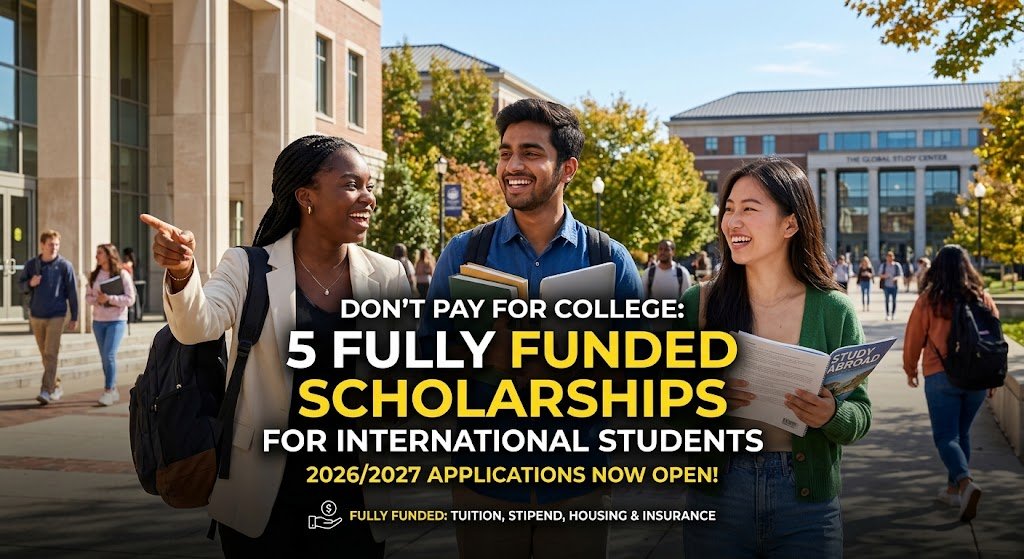
Explore fully funded USA University Scholarships for international students in 2026, including tuition coverage, living allowances, financial aid and application tips.
Fully funded USA scholarships can make studying at a U.S. university significantly more affordable for international students by covering some or all of the costs associated with higher education. Depending on the scholarship, funding may include tuition, accommodation, living expenses, health insurance, travel support, or other educational costs.
For international students planning to study in the United States in 2026, understanding which scholarships provide substantial financial support—and what each program actually covers—is an important part of the application process.
For international students, studying at a U.S. university can open doors to advanced academic training, professional networks, research opportunities, and careers in fields such as technology, engineering, finance, healthcare, and business. However, the cost of tuition, accommodation, health insurance, textbooks, and daily living expenses can make an American education financially challenging.
The good news is that some U.S. universities offer substantial need-based financial aid to international students. Depending on your family’s financial circumstances and the university’s policies, this support may cover tuition and other educational expenses, with additional assistance for housing, meals, books, and personal costs.
It is important to understand one distinction: fully funded university education is not automatically available to every admitted student, and a university’s financial aid policy is not the same as a guaranteed scholarship. Financial aid awards are typically determined after the institution evaluates the applicant’s demonstrated financial need.
For the 2026 admissions cycle, prospective students should examine official university financial aid policies, application deadlines, and international student requirements before making plans. This guide reviews five U.S. universities whose published undergraduate financial aid policies make them relevant to students seeking comprehensive financial support.
5 Fully Funded USA University Scholarship Opportunities in 2026
The universities below are discussed based on their official financial aid policies. They are not presented as a ranking, and none of the institutions guarantees admission or a full award to every applicant.

1. Harvard University
Undergraduate
Harvard states that international students are eligible for the same financial aid as U.S. students, and the university meets 100% of demonstrated financial need. Aid is based on financial need rather than merit scholarships.
Official source:

Harvard
2. Yale University
Undergraduate
Yale reports need-blind admission for international applicants and financial aid that meets 100% of demonstrated need. Its aid may include allowances for housing, meals, and travel.
Official source:
Undergraduate Admissions
3. Princeton University
Undergraduate
Princeton states that it meets the full demonstrated financial need of admitted international students through grants rather than loans. It does not offer academic or athletic merit scholarships for undergraduate students.
Official source:
Princeton Admission
4. Massachusetts Institute of Technology
Undergraduate
MIT commits to meeting 100% of demonstrated financial need for international undergraduate students. Its published affordability policy includes tuition-free thresholds for qualifying families.
Official source:
MIT Student Financial Services

5. Amherst College
Liberal arts
Amherst is a relevant institution to investigate for international undergraduate financial aid. Applicants should verify its current aid policy, eligibility conditions, and application requirements directly through the college’s official admissions and financial aid pages.
Verify current policy on the institution’s official website before applying.
1. Harvard University: Need-Based Financial Aid for International Students
Harvard University is one of the institutions that explicitly extends its undergraduate financial aid policies to international students. According to Harvard College Admissions, the financial aid process is the same for applicants regardless of nationality, and the university meets each student’s demonstrated financial need.
This is significant for applicants who may be academically competitive but unable to afford the full cost of studying in the United States.
What Harvard’s financial aid policy means
Harvard describes its financial aid as need-based rather than merit-based. This means the amount of assistance depends on an assessment of the student’s financial circumstances rather than simply academic performance.
For eligible students, financial aid may contribute toward the cost of attendance, which can include:
- Tuition and mandatory educational expenses.
- Housing and meals.
- Books and personal expenses.
- Other allowances included in the financial aid assessment.
Harvard also states that international students receiving financial aid have a travel allowance included in their financial aid award.
However, prospective applicants should not interpret this as an automatic full living stipend. The actual award depends on the university’s assessment and the student’s circumstances.
Official resources:
- Harvard International Applicants
- Harvard Financial Aid: How Aid Works
How to prepare for a Harvard application
International students should review the academic admission requirements and financial aid documentation before submitting an application. Financial documents may need to reflect income earned outside the United States, and applicants should follow Harvard’s instructions for reporting family income and assets.
If the application fee creates a financial hardship, Harvard provides information about fee waivers for qualifying applicants. Review the university’s official instructions rather than relying on third-party scholarship websites.
2. Yale University: Financial Aid That Can Cover Tuition and Living Costs
Yale University offers another significant pathway for international students seeking need-based undergraduate financial assistance. Its official international admissions information states that students are eligible for need-based aid, and Yale meets 100% of demonstrated financial need.
Yale’s policy is particularly relevant to students who need assistance beyond tuition alone.
What makes Yale’s financial aid relevant?
Yale reports that international student financial aid can include allowances for housing, meals, and travel to and from campus. Its financial aid awards are provided in the form of scholarships rather than loans.
The amount a student receives is determined by the institution’s assessment of family financial circumstances. As a result, applicants should not assume that the same financial package will be offered to every international student.
Yale’s affordability information also provides examples of how family income and assets can affect the expected contribution. These figures are institutional estimates and should be checked against the latest published information before an application is submitted.
Eligibility and application preparation
Applicants should consider the following steps:
- Review Yale’s undergraduate admission requirements.
- Indicate an interest in financial aid when completing the admission application.
- Submit the required financial documents through Yale’s specified process.
- Monitor the admissions status portal for additional requirements.
- Review the final financial aid award carefully before accepting admission.
Yale’s financial aid requirements for international applicants can differ from those for U.S. citizens, so students should use the international applicant instructions.
Official resources:
- Yale International Students
- Yale Affordability and Financial Aid
3. Princeton University: Grant-Based Financial Aid for International Undergraduates
Princeton University states that it meets the full demonstrated financial need of admitted international undergraduate students under the same financial aid policy applied to U.S. students.
A central feature of Princeton’s program is its use of grants rather than loans for undergraduate financial aid. Grants generally do not need to be repaid, subject to the terms and conditions of the award.
What expenses may be covered?
Princeton’s official affordability information describes financial aid that can cover the full cost of attendance for many families, including expenses such as:
- Tuition.
- Housing.
- Food.
- Books.
- Personal expenses.
The actual amount is determined individually based on the student’s family resources and financial circumstances.
Princeton also states that it does not offer academic or athletic merit scholarships for undergraduates. Its financial aid is based on demonstrated need.
This distinction is important for students searching for “fully funded merit scholarships.” A university can provide extensive need-based financial aid without awarding merit scholarships.
How international students can approach Princeton
Students should examine Princeton’s international applicant requirements and financial aid application instructions. Academic preparation, examination results, transcripts, recommendations, and financial documents may all be relevant.
Applicants should also distinguish undergraduate aid from graduate funding. Princeton publishes separate information for graduate programs, and funding arrangements can vary by degree level and department.
Official resources:
- Princeton International Students
- Princeton Cost and Aid
4. MIT: Financial Aid for International Students and Tuition-Free Thresholds
The Massachusetts Institute of Technology, commonly known as MIT, provides need-based financial aid to eligible international undergraduate students. MIT’s Student Financial Services website states that the institution is committed to meeting 100% of demonstrated financial need for international students.
MIT is especially relevant to applicants interested in engineering, computer science, scientific research, and technology-related education.
Understanding MIT’s tuition-free policy
MIT’s published affordability information says that, beginning with the 2025–2026 academic year, students from families earning under $200,000 annually with typical assets attend tuition-free. It also states that families earning less than $100,000 with typical assets are not expected to contribute toward their student’s MIT education.
These thresholds are not a guarantee of admission or an automatic full-cost award for every student. The policy refers to qualifying families and typical assets, and individual financial aid decisions depend on the university’s assessment.
Students should consult MIT’s official financial aid information for the current academic year and confirm the specific requirements applicable to international applicants.
MIT financial aid application requirements
MIT states that international students seeking undergraduate financial aid must submit a CSS Profile and parental tax returns or income documentation.
Applicants should prepare accurate financial records, including documents that explain family income and assets. If records are not in English, follow the university’s instructions regarding translations.
Official resources:
- MIT International Student Financial Aid
- MIT Cost and Financial Aid
5. Amherst College: Investigating Comprehensive Undergraduate Financial Aid
Amherst College is included as an additional institution for students researching U.S. undergraduate financial aid opportunities. It is a liberal arts college, rather than a research university, and applicants should consider whether its academic programs align with their goals.
Because financial aid rules and institutional commitments can change, applicants should verify Amherst’s current international student aid policy directly with the college before relying on a specific claim about full tuition or living expenses.
What to verify before applying
Students should look for clear information about:
- Whether international applicants are eligible for need-based aid.
- Whether the institution meets the full demonstrated financial need of admitted international students.
- Whether financial aid includes housing, food, insurance, and personal expenses.
- Which forms and supporting documents are required.
- Whether the aid policy applies to the intended degree level.
A credible scholarship guide should never present an unverified financial aid package as a guaranteed award.
Application resource: Visit the official Amherst College website and navigate to its international admissions and financial aid pages.
What Does “Fully Funded” Really Mean for International Students?
The phrase fully funded scholarship is widely used in online education content, but it does not always have one consistent meaning.
Some awards cover tuition only. Others cover tuition, accommodation, and meals. A smaller number of funding packages may also include books, insurance, transportation, or a personal expense allowance.
Before accepting a scholarship claim, check the exact financial coverage.
| Funding component | What to verify |
|---|---|
| Tuition | Is the full tuition bill covered, or only a portion? |
| Housing | Is university accommodation included? |
| Meals | Is a meal plan or food allowance provided? |
| Books and supplies | Are academic materials included? |
| Health insurance | Does the award include student insurance? |
| Travel | Is international travel included, and under what conditions? |
| Personal allowance | Is there a separate stipend, and how is it calculated? |
| Renewal | Must the student reapply or maintain academic conditions? |
A university’s published commitment to meeting demonstrated financial need does not automatically mean that every student receives the same award or a guaranteed cash stipend.
Need-Based Financial Aid vs. Merit Scholarships
These two categories are often confused.
Need-based financial aid is calculated using a student’s financial circumstances. The institution evaluates information such as family income, assets, household size, and other factors defined by its aid methodology.
Merit scholarships are generally awarded based on factors such as academic achievement, leadership, talent, or other selection criteria. The eligibility rules vary by institution and program.
A student can be academically outstanding and still receive need-based aid. Likewise, a student with substantial financial need may not qualify for a particular merit scholarship.
For accurate scholarship research, read the university’s official financial aid policy and determine whether the award is need-based, merit-based, or a combination of funding sources.
How to Apply for Fully Funded USA Scholarships in 2026
Finding a scholarship is only one part of the process. International students must generally complete an admission application, meet academic requirements, provide financial documentation where required, and plan for immigration procedures.
The following steps can help applicants organize their preparation.
Step 1: Choose the Correct Degree Level
Start by deciding whether you want to study for an undergraduate degree, master’s degree, or Ph.D.
The five institutions discussed above primarily relate to undergraduate financial aid policies. Graduate funding is a separate topic, and many graduate scholarships depend on departments, research projects, assistantships, or fellowship programs.
Do not assume that a university’s undergraduate financial aid policy automatically applies to its master’s or doctoral programs.
Step 2: Check Academic Admission Requirements
Each university has its own requirements. These may include:
- Academic transcripts.
- Examination results.
- Standardized tests where required.
- Personal essays or supplemental writing.
- Recommendation letters.
- English language proficiency evidence, where applicable.
- Other documents specified by the admissions office.
For international applicants, academic records may need to be translated or submitted in a particular format. Follow the official institution’s instructions instead of relying exclusively on generalized scholarship checklists.
Step 3: Prepare Your Financial Documents
Students requesting need-based financial aid should expect to provide information about their financial circumstances.
Depending on the university, this may include:
- Parent or guardian income records.
- Tax documentation or equivalent income evidence.
- Information about family assets.
- Household size.
- Explanations of unusual financial circumstances.
The precise documents differ between institutions. For example, MIT describes the use of the CSS Profile and parental tax or income documentation for international financial aid applicants. Harvard and Yale also provide institution-specific financial aid instructions.
Submit accurate information. Misrepresenting income, assets, academic history, or personal circumstances can affect an application and potentially lead to the withdrawal of an award.
Step 4: Submit Financial Aid Applications on Time
A student may be admitted to a university but fail to receive the expected financial support if the financial aid application is incomplete or submitted incorrectly.
Before applying, confirm:
- The financial aid deadline.
- The forms required for international applicants.
- Whether supporting documents must be translated.
- Whether financial aid must be requested during the admission application.
- Whether additional documents may be requested later.
Save copies of submitted forms and monitor the institution’s applicant portal for updates.
Step 5: Compare the Final Financial Aid Award
Do not compare scholarships only by their advertised title.
A financial aid offer should be reviewed against the actual cost of attendance and the expenses you will be responsible for paying.
Consider whether the award includes tuition, housing, meals, books, insurance, travel, and personal costs. If there is an expected family contribution, determine whether your family can meet it.
A clear understanding of the award can help prevent financial difficulties after enrollment.
How to Improve Your Chances of Receiving University Financial Aid
There is no guaranteed strategy for obtaining admission or a fully funded award at a highly selective university. However, applicants can improve their preparation and reduce avoidable errors.
Build a Strong Academic Record
A competitive academic record is important for selective universities. Focus on understanding your curriculum, performing well in relevant subjects, and demonstrating consistent academic preparation.
If your intended field is engineering, for example, relevant mathematics and science coursework may help demonstrate preparation for the program. Applicants should check the actual academic expectations of their chosen course.
Write an Authentic Personal Statement
A personal statement should explain your experiences, interests, motivations, and goals in your own words.
Avoid making unsupported claims about achievements or copying generic essays from scholarship websites. Strong writing is specific, truthful, and connected to the applicant’s background.
Demonstrate Meaningful Engagement
Activities outside the classroom can help admissions officers understand an applicant’s interests and contributions. These activities do not need to be expensive or prestigious.
Examples may include:
- Community service.
- School leadership.
- Research projects.
- Independent learning.
- Creative work.
- Family responsibilities.
- Relevant work experience.
The most useful approach is to describe what you actually did and what you learned rather than simply listing impressive-sounding labels.
Research Each Institution’s Financial Aid Methodology
One of the most important steps is understanding how the university determines financial need.
A student should not assume that the same family income will result in the same aid award at every institution. Universities may use different methodologies and may consider different types of assets, expenses, or family circumstances.
Use the official financial aid office as the primary source of information.
USA Student Visa Requirements for International Scholarship Recipients
Receiving a university scholarship does not automatically grant permission to enter or study in the United States.
International students must comply with the relevant U.S. immigration requirements. For academic university study, the F-1 student visa is commonly used.
The U.S. Department of State explains that students attending a university or college generally need an F visa. Students must first be accepted by an eligible institution and complete the required steps before applying for the visa.
Students comparing funding options can also explore fully funded US scholarships. Fully Funded Scholarships in the United States: Eligibility, Applications and Career Opportunities
For more guidance, take a look at our related guide: US Scholarships for International Students: 2026 Guide to Financial Aid, Study Costs & High-Demand Careers
Basic Student Visa Process
The general process includes:
- Apply to an appropriate U.S. university or college.
- Receive an admission decision.
- Obtain the relevant documentation from the institution, including Form I-20 where applicable.
- Pay required fees and complete the visa application process.
- Attend a visa interview when required.
- Prepare for travel and entry according to the applicable rules.
The U.S. Department of State states that F-1 and M-1 students must be enrolled at a school certified by the Student and Exchange Visitor Program (SEVP).
Can a Scholarship Cover Visa and Travel Costs?
Some university financial aid packages may include travel allowances or other relevant support. However, coverage varies by institution and by the student’s financial aid award.
Applicants should not assume that every scholarship pays visa application fees, flights, or all pre-arrival costs.
For official immigration guidance, use these resources:
- U.S. Department of State: Student Visa
- USAGov: Get a Student Visa to Study in the U.S.
- EducationUSA: Apply for Your Student Visa
Important: Immigration rules, fees, appointment requirements, and visa procedures can change. Verify the current instructions through the U.S. Department of State and the U.S. embassy or consulate handling your application.
Understanding Study Costs Beyond Tuition
A scholarship that removes tuition expenses can still leave students responsible for other costs. Before accepting an offer, create a realistic financial plan.
Potential expenses include:
- Passport and document preparation.
- Application-related expenses.
- Visa application fees.
- International transportation.
- Personal items and initial accommodation arrangements.
- Health insurance, depending on the university’s coverage.
- Costs not included in the financial aid package.
The exact amounts vary by destination, university, personal circumstances, and award terms.
Students should also consider currency exchange rates and the cost of transferring money internationally. A financial plan that looks manageable in one currency may become more expensive if exchange rates change.
Why a Net Price Calculator Can Help
Some universities offer a net price calculator or other financial aid estimation tools. These tools can help prospective students understand potential costs before applying.
An estimate is not a formal financial aid award. The final award depends on the institution’s review of the student’s submitted information.
When comparing universities, consider both the estimated cost of attendance and the likely family contribution rather than focusing only on the advertised tuition figure.
Common Mistakes to Avoid When Searching for Fully Funded Scholarships
The internet contains many scholarship articles, social media posts, and promotional websites. Not every claim is accurate or current.
Here are some common mistakes applicants should avoid.
1. Believing Every “100% Scholarship” Claim
A headline may advertise a 100% scholarship without explaining what the percentage refers to.
Does it cover tuition only? Is housing included? Is the award renewable? Is it available to international students?
Read the original scholarship terms before making financial or travel decisions.
2. Paying Unverified Scholarship Agents
Some applicants pay individuals or companies that promise guaranteed admission, visa approval, or a fully funded scholarship.
No third party can guarantee admission to a selective university or guarantee that a visa will be approved.
If you use an education consultant, verify the services, costs, and representations carefully. You can also contact the university directly to confirm whether an individual or organization is authorized to represent it.
3. Missing the Financial Aid Deadline
Admission deadlines and financial aid deadlines may not be identical. An applicant who submits an admission application but fails to complete the required aid process may encounter problems.
Always check the university’s official deadline information.
4. Using Outdated Information
Scholarship eligibility, income thresholds, testing requirements, and application procedures may change from year to year.
A page published several years ago may no longer reflect the current policy. Confirm information using official institutional sources.
5. Assuming a Scholarship Guarantees a Visa
A financial aid award can help demonstrate how educational expenses will be funded, but it does not guarantee visa approval.
Applicants must satisfy the applicable immigration requirements and follow the current instructions from the U.S. Department of State.
SEO and Google AdSense Compliance Checklist for Biodynasty
The goal of a high-quality scholarship article should be to attract readers through useful, accurate information—not misleading promises about admission, financial awards, or immigration outcomes.
For AdSense-oriented publishing, use the following editorial checklist.
Content quality checklist
Use accurate, verifiable scholarship and financial aid information.Distinguish need-based aid from merit scholarships.Avoid guaranteed admission, scholarship, or visa promises.Link important factual claims to official university and government sources.Use natural keyword placement rather than repetitive keyword stuffing.Provide clear headings, readable paragraphs, and useful navigation.Avoid misleading advertising language or deceptive claims about costs.Review the current Google Publisher Policies before monetization.
High-Intent SEO Keywords to Use Naturally
These keywords may help align the article with relevant search intent, but no keyword guarantees a particular advertising rate or search ranking.
| Keyword | Search intent |
|---|---|
| Fully funded scholarships in the USA | Scholarship discovery |
| USA university scholarships for international students | University financial aid |
| Full tuition scholarships USA | Tuition funding |
| Need-based financial aid for international students | Financial aid research |
| Study in the USA with full funding | Education planning |
| International student scholarships 2026 | Current scholarship research |
| U.S. student visa requirements | Immigration information |
| Cost of studying in the USA | Financial planning |
| Financial aid for international undergraduate students | Funding eligibility |
Editorial recommendation: Use the main keyword in the title, introduction, and a relevant heading. Include related phrases where they genuinely clarify the topic. Avoid repeating a keyword in every paragraph.
Avoiding Navigation Issues on Your Website
A scholarship article should be easy to navigate on desktop and mobile devices.
Recommended practices include:
- Use a clear table of contents for long-form content.
- Organize information under descriptive headings.
- Make official external links identifiable.
- Check that internal links lead to relevant, accessible pages.
- Avoid excessive pop-ups or intrusive page elements.
- Ensure the featured image does not interfere with reading.
- Check mobile responsiveness before publishing.
- Use descriptive link text rather than repeatedly displaying raw URLs.
A good user experience helps readers find the information they need without unnecessary friction.
Frequently Asked Questions
1. Can international students receive fully funded scholarships in the USA?
Yes, some U.S. universities provide substantial need-based financial aid to eligible international students. However, the availability and amount of funding depend on the institution, degree level, admission decision, and financial circumstances.
2. Do fully funded scholarships cover living expenses?
Some financial aid packages can include housing, meals, and other living-related costs. Coverage is not universal, so applicants must review the official award details.
3. Is Harvard free for international students?
Harvard offers need-based financial aid to international students and meets 100% of demonstrated financial need. Whether an individual student pays no tuition or receives support for other expenses depends on the financial aid assessment.
4. Can I apply for scholarships without taking the SAT?
Testing requirements vary by institution and admission cycle. Applicants should check the current official requirements for the university and program they are applying to.
5. Do scholarship recipients automatically receive a U.S. student visa?
No. A scholarship does not automatically guarantee a visa. Students must follow the applicable U.S. student visa process and satisfy the relevant requirements.
6. Are these scholarships available for master’s degrees?
The universities in this guide are primarily discussed in relation to undergraduate financial aid. Graduate funding differs by institution and program. Prospective master’s and Ph.D. students should research department-specific funding, fellowships, and assistantships.
Final Thoughts: How to Plan Your 2026 Scholarship Search
Studying in the United States with substantial financial support is a realistic goal for some international students, but it requires careful research and preparation.
Harvard, Yale, Princeton, and MIT publish significant need-based financial aid policies for international undergraduates. Amherst is another institution that applicants can investigate through its official admissions and financial aid resources. These institutions should be evaluated according to their actual eligibility rules and the applicant’s academic and financial circumstances.
The most important next step is to verify the current admission and financial aid requirements directly with each university. Prepare your academic records, financial documentation, and application materials early. Then assess the complete financial aid award rather than relying solely on the phrase “fully funded.”
A well-researched scholarship application can help you make informed decisions about education costs, university selection, and the U.S. student visa process.
Author Box
Dynamo Gills
Writer & Researcher at Biodynasty
Dynamo Gills is a writer and researcher at Biodynasty, covering international education, scholarships, immigration information, and career opportunities. The focus is on clear, practical content that helps readers research educational and professional pathways.

 Dynamo