 Dynamo
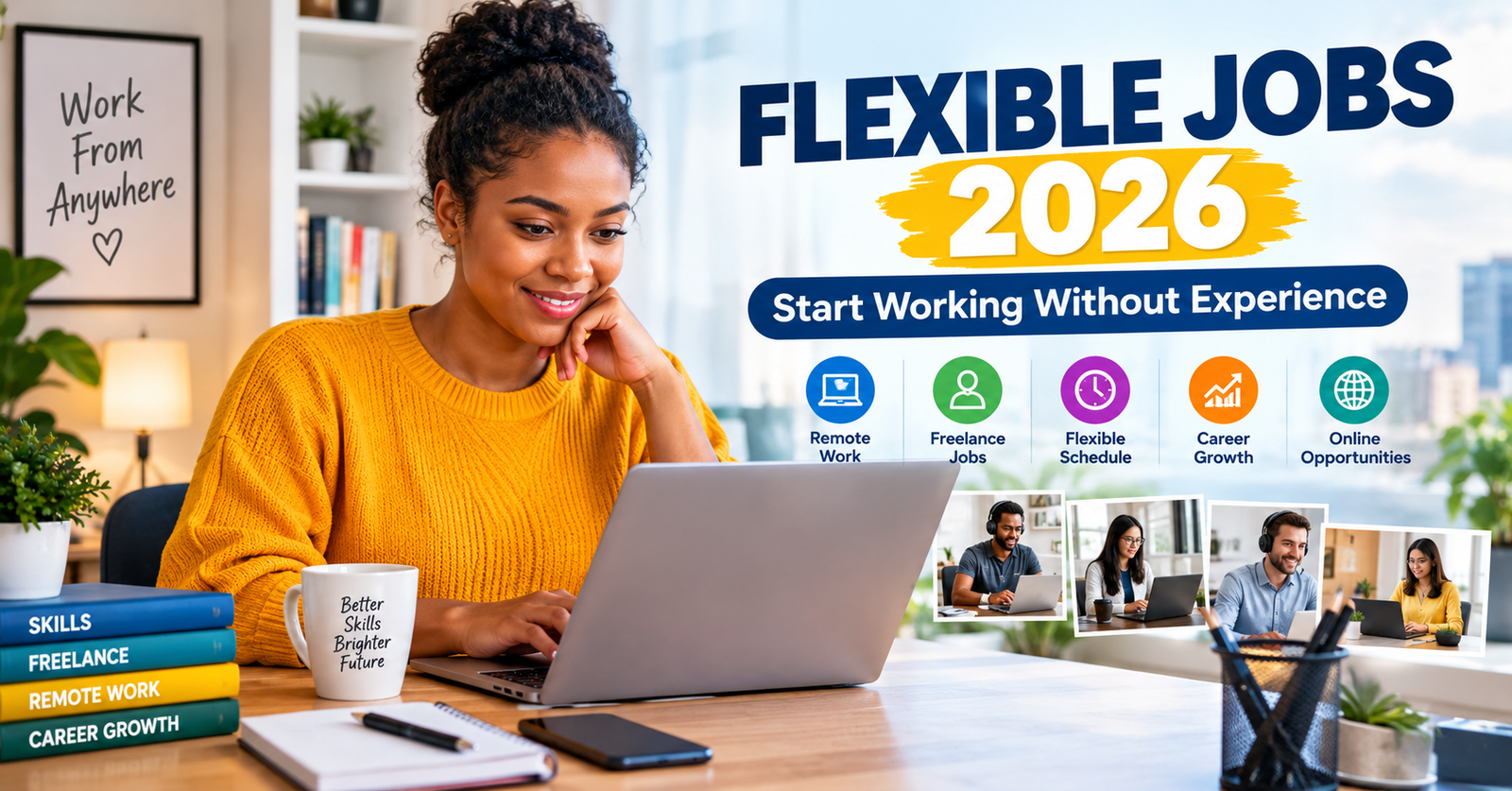
Explore flexible jobs in 2026 that may be available without prior experience. Learn about remote work, online jobs, freelance opportunities, requirements, pay factors, and how to get started.
Finding work without years of professional experience can feel difficult, particularly when many job advertisements seem to demand skills, qualifications and previous employment. The good news is that flexible jobs in 2026 cover a much broader range of opportunities than traditional nine-to-five employment.
Flexible work can include remote customer service, virtual assistance, administrative support, sales, freelance services, online tutoring, content-related work, part-time employment and other arrangements that allow workers to control some combination of their location, schedule or workload.
However, flexibility should not be confused with guaranteed easy money.
The most sustainable opportunities generally involve providing a useful service to an employer, client or customer. Even when a position does not require previous professional experience, employers may still expect communication skills, reliability, basic computer knowledge, attention to detail or the ability to learn quickly.
This guide explains how to identify legitimate opportunities, build experience from scratch, avoid common employment scams and understand work-authorization requirements when applying internationally.
Important: Salary figures and employment statistics in this article are examples based primarily on U.S. government labor-market data. Actual pay varies significantly by country, employer, location, experience, hours and contract type.
Table of Contents
- What Are Flexible Jobs in 2026?
- Can You Get Flexible Work Without Experience?
- Best Flexible Jobs for Beginners
- Remote Customer Service Jobs
- Virtual Assistant and Administrative Jobs
- Freelance Jobs for Beginners
- Flexible Sales and Business Development Jobs
- Online Tutoring and Skills-Based Work
- How to Find Legitimate Flexible Jobs
- How to Apply Without Previous Experience
- How to Build a Resume for Flexible Jobs
- How to Increase Your Earning Potential
- Flexible Jobs and International Work Opportunities
- Work Authorization and Immigration Requirements
- How to Avoid Flexible Job Scams
- A 30-Day Plan for Finding Flexible Work
- Frequently Asked Questions
- Final Thoughts
What Are Flexible Jobs in 2026?
Flexible jobs in 2026 are employment or income opportunities that provide some degree of flexibility around working hours, location, workload or employment structure.
There are several common forms of flexibility.
1. Remote work
Remote employees perform their duties away from a traditional office. Depending on the employer, this could mean working entirely from home or following a hybrid arrangement.
2. Part-time employment
Part-time jobs generally involve fewer working hours than full-time employment. These positions can be useful for students, parents, people changing careers or workers who need another source of income.
3. Freelancing
Freelancers provide services to clients rather than working as traditional employees. Common freelance services include writing, graphic design, video editing, programming, translation and virtual assistance.
4. Contract work
A contractor may work for an organization for a defined period or project. Contract arrangements can provide flexibility, although the worker’s legal classification and benefits vary by jurisdiction.
5. Flexible scheduling
Some employers allow workers to choose from different shifts or adjust their schedules within defined limits.
The important distinction is that flexible does not necessarily mean unlimited freedom. A remote customer-service employee, for example, may still have fixed working hours.
Can You Get Flexible Work Without Experience?
Yes, but it is important to define “without experience” realistically.
You may have no formal employment history while still possessing useful skills.
For example, someone who has:
- Managed a personal social-media page
- Helped a family business
- Organized community activities
- Used spreadsheets
- Written school or university assignments
- Managed online communications
- Created videos
- Translated between languages
- Sold products
- Helped customers
- Used Microsoft Office or Google Workspace
may already have transferable skills.
Employers frequently care about whether an applicant can perform the actual duties of a position.
For example, U.S. Bureau of Labor Statistics data show that customer service representatives typically need a high school diploma or equivalent rather than a university degree, and employers generally provide short-term on-the-job training. The occupation had a median annual wage of $44,770 in May 2025.
That doesn’t mean every customer-service position pays that amount or can be performed remotely. It illustrates why entry-level occupations can provide a practical starting point for people building professional experience.
Best Flexible Jobs for Beginners
The following categories can be worth researching if you have limited formal experience.
| Job category | Potential flexibility | Typical beginner requirement |
|---|---|---|
| Customer service | Remote/shift-based | Communication skills |
| Virtual assistant | Remote | Organization and computer skills |
| Data-related administrative work | Remote/office | Accuracy and basic software skills |
| Sales development | Remote/hybrid | Communication and persistence |
| Online tutoring | Remote | Subject knowledge |
| Freelance writing | Remote | Writing ability |
| Social media assistance | Remote | Social-media knowledge |
| Transcription | Remote | Listening and typing ability |
| Appointment setting | Remote | Communication skills |
| Online research assistance | Remote | Research and organization |
| Graphic design | Remote | Portfolio/software skills |
| Video editing | Remote | Editing ability |
These aren’t guaranteed employment opportunities. Requirements differ by employer and country.
The best option depends on the skills you already have and the type of flexibility you need.
Remote Customer Service Jobs
Customer service is one of the more accessible areas for people entering the workforce.
Customer-service representatives answer questions, resolve customer problems, process orders and provide information about products or services. BLS data indicate that these workers can be employed across numerous industries, including retail, insurance, business services and professional services.
Some employers also permit customer-service representatives to work from home.
Skills employers may look for
You can improve your competitiveness by demonstrating:
- Clear written communication
- Professional telephone skills
- Basic computer literacy
- Patience
- Problem-solving
- Attention to detail
- Ability to follow procedures
- Customer-focused communication
You don’t necessarily need an elaborate qualification to start building these skills.
How to gain experience
One useful approach is to create a small practice portfolio.
For example, prepare five sample customer-service responses covering:
- A refund request
- A delayed order
- A product complaint
- A technical question
- A dissatisfied customer
This can demonstrate your ability to communicate professionally.
Virtual Assistant and Administrative Jobs
Virtual assistants support individuals or businesses with routine administrative activities.
Tasks may include:
- Managing calendars
- Organizing documents
- Responding to emails
- Researching information
- Preparing spreadsheets
- Scheduling appointments
- Updating databases
- Preparing simple reports
These jobs can be particularly suitable for people who are organized and comfortable with computers.
A beginner can develop a basic portfolio using tools such as spreadsheets, word processors, calendars and presentation software.
Instead of simply telling employers, “I am hardworking,” demonstrate what you can actually do.
For example, create:
- A sample weekly calendar
- A simple expense spreadsheet
- A professionally formatted document
- A sample customer-email response
- A basic project tracker
These examples can make an inexperienced applicant easier to evaluate.
Freelance Jobs for Beginners
Freelancing can provide significant flexibility because freelancers can potentially work with multiple clients.
However, freelancing is not the same as receiving a guaranteed salary.
Your income can fluctuate, and you may have to find clients yourself.
Beginner-friendly freelance services can include:
Writing
If you have strong writing skills, you can explore:
- Blog writing
- Product descriptions
- Website copy
- Proofreading
- Editing
- Research assistance
Graphic design
Beginners familiar with design software can create:
- Social-media graphics
- Presentation designs
- Flyers
- Business documents
- Simple advertisements
Video editing
Short-form video has created demand for editing services involving:
- Captions
- Cutting footage
- Resizing videos
- Basic transitions
- Social-media formatting
Translation
People who speak more than one language fluently can investigate translation and localization opportunities.
The key is to avoid presenting yourself as an expert before you have the required ability. Start with services you can genuinely deliver.
Flexible Sales and Business Development Jobs
Sales is another area where formal experience may not always be essential.
Some sales-related positions provide structured training and use performance-based compensation.
For someone with strong communication skills, this can include:
- Sales development
- Appointment setting
- Lead qualification
- Customer acquisition
- Account support
- Business development
U.S. labor data show that sales occupations encompass a wide range of roles and that there are substantial annual openings across the occupational group, although employment prospects vary considerably between individual occupations.
Compensation can also vary substantially because some sales positions include commissions or bonuses.
Before accepting a role, understand:
- Base salary
- Commission structure
- Performance targets
- Payment schedule
- Employment classification
- Working hours
- Whether training is paid
Never assume that a large advertised earning figure represents guaranteed income.
Online Tutoring and Skills-Based Work
If you are good at a particular subject, online tutoring can provide another flexible option.
Potential areas include:
- Mathematics
- Languages
- Science
- Music
- Computer skills
- Academic writing
- Test preparation
The requirements vary widely.
Some tutoring companies require degrees or teaching credentials, while other platforms or private clients may focus more heavily on demonstrated subject knowledge.
You can begin by identifying one subject you understand particularly well and developing a simple lesson plan.
How to Find Legitimate Flexible Jobs
Finding the opportunity is only half the process. You also need to verify that the employer or client is legitimate.
Start with established job boards, company career pages, government employment services and professional networks.
Search using specific terms
Instead of searching only for:
“Work from home”
try more specific searches such as:
- Remote customer service representative
- Remote administrative assistant
- Entry-level remote jobs
- Part-time virtual assistant
- Remote appointment setter
- Junior content assistant
- Remote sales development representative
- Freelance writing jobs
- Remote data-entry jobs
Specific searches generally produce more relevant results.
Research the employer
Before accepting an offer, look for:
- Official company website
- Corporate registration information where applicable
- Physical business information
- Verifiable employees
- Company career page
- Consistent contact information
- Clear job responsibilities
- Written employment terms
Be particularly cautious when someone demands money before providing a job.
How to Apply Without Previous Experience
Your application should focus on evidence of ability, not simply the absence of experience.
Instead of saying:
“I don’t have experience.”
show employers what you can do.
For example:
“Created a sample customer-support workflow demonstrating professional written responses to common customer inquiries.”
That statement gives an employer something concrete to evaluate.
Use transferable experience
Consider activities such as:
- Volunteer work
- School projects
- Personal projects
- Community activities
- Freelance assignments
- Family-business responsibilities
- Online courses
- Internships
- Portfolio projects
These can demonstrate relevant skills even if they weren’t traditional employment.
How to Build a Resume for Flexible Jobs
A beginner’s resume doesn’t need to be several pages long.
A straightforward structure can include:
Professional summary
Write two or three sentences explaining the type of work you’re targeting and the skills you bring.
Skills
Include relevant skills such as:
- Customer service
- Microsoft Office
- Google Workspace
- Communication
- Data entry
- Scheduling
- Research
- Social media
- Writing
- Spreadsheet management
Projects
Create a section for relevant projects if your formal employment history is limited.
Education
List relevant qualifications, courses and certifications.
Experience
Include employment, volunteer work, internships and other genuine experience.
Avoid inventing employers, job titles or responsibilities.
A truthful beginner resume is much safer than an impressive-looking resume containing information that cannot be verified.
How to Increase Your Earning Potential
A common mistake is focusing exclusively on finding the highest advertised hourly rate.
A better long-term strategy is to increase your market value.
For example:
Basic skill → specialized skill → proven results → higher-value service
A beginner virtual assistant might initially provide general administrative assistance.
Over time, they might specialize in:
- E-commerce administration
- Real-estate administration
- Executive assistance
- CRM management
- Project coordination
Specialization can make it easier to distinguish yourself from applicants offering identical general services.
Similarly, a beginner writer can eventually specialize in:
- Financial content
- Technology
- Healthcare
- Legal content
- B2B writing
- Software documentation
Specialization should be based on genuine knowledge and capability.
Flexible Jobs and International Work Opportunities
Flexible work can also attract people who are interested in international employment.
However, there is an important distinction between working remotely for a foreign company from your own country and physically moving to another country to work.
Immigration rules apply to the second situation, and sometimes to the first depending on the employment arrangement and local laws.
You should never assume that a foreign job advertisement automatically gives you the right to work in that country.
Work Authorization and Immigration Requirements
If your goal is to work physically in another country, always check the relevant government’s immigration website.
Canada
Canada’s official immigration portal explains that most foreign nationals need a work permit to work in Canada, although exemptions exist for specific circumstances. Canada distinguishes between employer-specific work permits and open work permits.
For applicants outside Canada, the government provides an official work-permit application process covering eligibility, documentation, submission, processing and arrival requirements.
Government of Canada — Work in Canada
United Kingdom
The UK Skilled Worker route generally requires an eligible job with an approved employer, a certificate of sponsorship and compliance with applicable salary requirements.
The UK government also maintains an official overview of work visas, including the Skilled Worker and Health and Care Worker routes.
Australia
Australia’s Department of Home Affairs states that people who want to work in Australia generally need a visa appropriate to the work they intend to perform. Its official resources cover temporary, provisional, regional and permanent work pathways.
Some Australian visas have work restrictions, and a visitor visa or ETA does not authorize ordinary employment.
Australian Department of Home Affairs — Working in Australia
United States
U.S. employment authorization depends on immigration status and eligibility. Certain foreign nationals may need an Employment Authorization Document, while others may have employment authorization connected to their status.
USCIS explains that eligible individuals may use Form I-765 to request employment authorization and an Employment Authorization Document.
USCIS — Employment Authorization
Always check the official immigration authority before paying an agent, accepting an overseas position or traveling for employment.
How to Avoid Flexible Job Scams
The growth of remote work has also created opportunities for fraudulent job advertisements.
Be cautious if an alleged employer:
- Requests an unexplained upfront payment
- Promises unusually high earnings for almost no work
- Guarantees employment without an interview
- Requests sensitive financial information too early
- Uses only an unofficial email address
- Refuses to provide written job details
- Sends you a check and asks you to return part of the money
- Asks you to purchase expensive equipment from a specific seller
- Pressures you to act immediately
- Requires cryptocurrency or gift-card payments
A legitimate employer may have genuine onboarding expenses or paperwork, but applicants should independently verify why any payment is required.
Never allow the desire for flexible employment to override basic due diligence.
A 30-Day Plan for Finding Flexible Work
You don’t need to apply randomly to hundreds of jobs.
A focused approach can be more useful.
Days 1–5: Identify your skills
Write down everything you can genuinely do.
Include:
- Computer skills
- Communication
- Writing
- Languages
- Organization
- Sales
- Design
- Video editing
- Customer support
- Research
Then choose two or three areas to target.
Days 6–10: Build your application materials
Create:
- A targeted resume
- A professional email address
- A LinkedIn profile if appropriate
- A simple portfolio
- Two or three customized application templates
Days 11–15: Build proof
Create sample projects.
If you’re targeting customer service, create sample responses.
If you’re targeting writing, create two or three articles.
If you’re targeting design, create several sample graphics.
If you’re targeting administrative work, create sample spreadsheets and project trackers.
Days 16–22: Apply strategically
Apply to positions that genuinely match your skills.
Customize the resume where appropriate.
Keep a spreadsheet containing:
- Company
- Position
- Application date
- Contact
- Status
- Follow-up date
Days 23–30: Improve and repeat
Look at the applications that received responses.
If employers repeatedly reject you for the same missing skill, address that skill.
If your applications receive no responses, review:
- Your resume
- Your keywords
- Your portfolio
- The types of positions you’re targeting
- Whether you’re meeting the stated requirements
The goal is continuous improvement rather than simply increasing the number of applications.
Frequently Asked Questions
What are the best flexible jobs in 2026 for beginners?
Potential options include customer service, virtual assistance, administrative support, sales development, tutoring and selected freelance services. The right choice depends on your skills, location and schedule.
Can I get a remote job without experience?
Yes. Some entry-level remote positions provide training or have relatively modest experience requirements. Customer service is one example; U.S. BLS data indicate that these positions typically require a high school diploma or equivalent and short-term on-the-job training.
Can I earn money online without experience?
Yes, but earnings are not guaranteed. Freelancing, tutoring, virtual assistance and other online services can provide opportunities if you have a skill that someone is willing to pay for.
Are flexible jobs legitimate?
Many are, but scams exist. Verify the employer, understand the compensation structure and be cautious about requests for upfront payments or financial information.
Can international workers get flexible jobs?
International workers can find remote or flexible employment, but physical employment in another country generally requires appropriate immigration or work authorization. Requirements depend on the country, visa category and employment arrangement.
Can I work remotely for a foreign company?
Possibly, but the legal and tax implications depend on where you live, where the employer is located, your employment classification and the nature of the work. Don’t assume that “remote” automatically eliminates local legal or tax requirements.
Do flexible jobs pay less?
Not necessarily. Compensation depends on the occupation, industry, experience, location and employment arrangement. Flexibility and salary are separate characteristics of a job.
Final Thoughts
The biggest advantage of flexible jobs in 2026 is not simply the ability to work from home. It is the wider range of ways people can structure their working lives.
Someone starting without formal experience can begin with an entry-level position, freelance service, part-time opportunity or skills-based role and gradually develop professional experience.
The most reliable strategy is to avoid promises of effortless income and instead build something employers and clients can verify: useful skills, real examples of your work, a credible resume and a consistent record of delivering results.
If you’re interested in international employment, treat immigration as a separate part of the process. Verify work authorization directly through the relevant government website before making financial commitments or traveling.
For U.S. labor-market information, the Bureau of Labor Statistics provides occupational wage, education and employment data. For international work, use official immigration authorities such as Canada.ca, GOV.UK, USCIS and Australia’s Department of Home Affairs.
That combination—practical skills, legitimate job-search methods and careful verification—provides a much stronger foundation than any advertisement promising instant income.
Author Box
Dynamo Gills
Writer & Researcher at Biodynasty
Dynamo Gills is a writer and researcher focused on employment, career development, international opportunities, digital work and practical financial topics. His work emphasizes clear, accessible information and encourages readers to verify important employment, legal and immigration information through authoritative sources before making decisions.

 Dynamo