 Dynamo
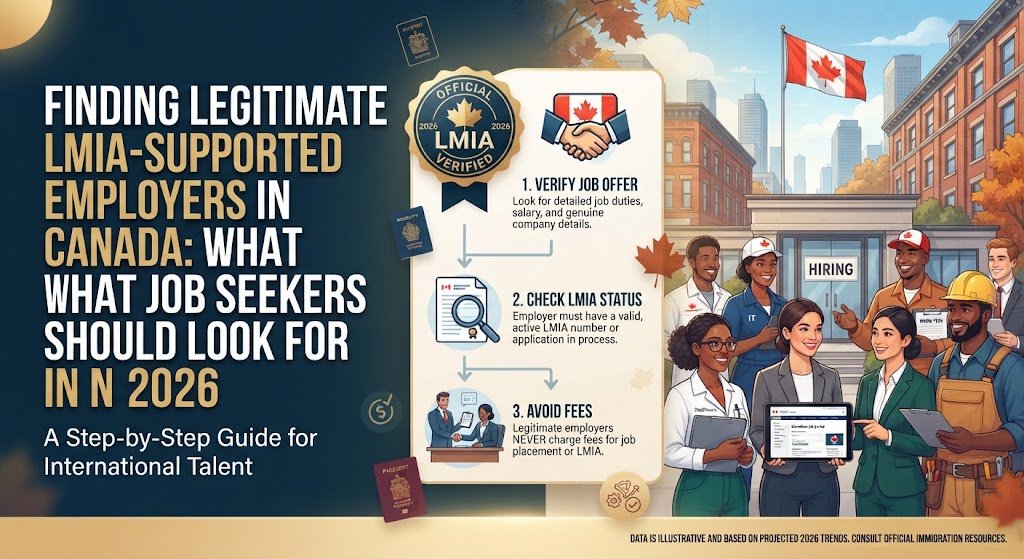
Learn how to identify legitimate LMIA-supported employers in Canada in 2026, verify job offers, avoid recruitment scams, and understand the Canadian work permit process.
Table of Contents
- What Is an LMIA and Why Does It Matter?
- What “LMIA-Supported Employer” Really Means
- Where to Find Legitimate LMIA-Supported Employers in Canada
- Use the Government of Canada Job Bank
- Check the Official Positive LMIA Employer Data
- Verify the Employer Before Applying
- What a Genuine Canadian Job Offer Should Contain
- LMIA Fees: Who Is Responsible for Paying?
- Recruitment Fees and Immigration Scams
- Check Whether an Employer Has Been Found Non-Compliant
- Why an LMIA Does Not Automatically Mean a Work Permit
- High-Demand Industries and LMIA Opportunities
- How to Evaluate a Job’s Salary and Working Conditions
- Using Immigration Representatives Safely
- A Practical LMIA Employer Verification Checklist
- Frequently Asked Questions
- Final Thoughts
What Is an LMIA and Why Does It Matter?
For international job seekers, finding LMIA-supported employers in Canada can be an important part of exploring employment-based immigration and temporary work opportunities.
LMIA stands for Labour Market Impact Assessment. It is an assessment conducted by Employment and Social Development Canada (ESDC) to determine whether hiring a temporary foreign worker is justified under the applicable Temporary Foreign Worker Program requirements.
For many employer-specific work permits, the employer must obtain an LMIA before the foreign worker applies for a work permit. A positive LMIA generally indicates that the employer has demonstrated a need to hire a foreign worker under the applicable program requirements.
However, job seekers should understand an important distinction:
An LMIA is not a work visa, and an employer advertising an LMIA-supported position does not automatically guarantee that a foreign applicant will receive a Canadian work permit.
The worker must still satisfy Canada’s immigration requirements, and the employer must provide the required documentation.
For official guidance, applicants should consult Canada’s employer-specific work permit information before making immigration or employment decisions.
What “LMIA-Supported Employer” Really Means
The phrase “LMIA-supported employer” can be confusing because it is sometimes used loosely in online job advertisements.
An employer may have:
- already received a positive LMIA;
- submitted an LMIA application that is still being processed;
- previously received LMIAs but not necessarily have a current position available;
- a position that is LMIA-exempt rather than LMIA-supported; or
- no legitimate LMIA position at all despite what an advertisement claims.
Canada’s Job Bank specifically distinguishes between jobs where an LMIA has been requested and jobs where an LMIA has already been approved.
This distinction matters.
A job advertisement saying “LMIA available” should not automatically be interpreted as proof that a particular applicant has a positive LMIA waiting for them.
The safest approach is to examine the actual employer, position, employment terms, and immigration documentation rather than relying on promotional language.
Where to Find Legitimate LMIA-Supported Employers in Canada
One of the biggest advantages available to international job seekers is that the Canadian government provides several official resources that can be used to research employers and employment opportunities.
A sensible search strategy involves three layers:
- Find the job through a credible source.
- Research the employer independently.
- Verify the immigration information before paying anyone or submitting an application.
This approach is particularly important because immigration fraud can involve fake job offers, fake documents, unauthorized representatives and promises of guaranteed visas.
The Government of Canada warns that nobody can guarantee a job or a Canadian visa.
Use the Government of Canada Job Bank
For many international applicants, the Government of Canada’s Job Bank is one of the most useful starting points.
The Temporary Foreign Worker section allows job seekers to search for Canadian employers that want to recruit temporary foreign workers. Job postings can include information such as:
- employer name;
- job title;
- location;
- salary;
- application instructions;
- posting date; and
- information indicating whether an LMIA has been requested or approved.
Job Bank also states that searching and applying for these jobs is free and that employers should never ask applicants to pay them to be hired.
You can begin your search through the official Government of Canada Job Bank Temporary Foreign Worker portal.
Search by occupation, not just “LMIA”
Instead of searching only for the phrase “LMIA job,” consider searching for your actual occupation.
Examples include:
- truck driver;
- welder;
- cook;
- food service supervisor;
- construction worker;
- heavy equipment operator;
- agricultural worker;
- caregiver;
- software developer;
- engineer;
- industrial mechanic;
- machinist; or
- hospitality professional.
This can produce more relevant results because employers generally advertise actual occupations rather than selling an immigration product.
Check the Official Positive LMIA Employer Data
Another useful resource is Canada’s Open Government data.
The Government of Canada publishes datasets identifying employers that received positive LMIAs, organized by information such as program stream, National Occupational Classification (NOC) and business location.
The most recent dataset available as of September 2026 includes employers issued positive LMIAs during January to March 2026. It was published in July 2026 and is available as an Excel dataset.
You can consult the 2026 Q1 Positive LMIA Employers List directly.
This is particularly useful when researching an employer whose name appears in an online advertisement.
But don’t treat the list as a guarantee
A positive LMIA record should be viewed as one verification point, not proof that every current job advertisement from that employer is legitimate.
A company could have received an LMIA for a particular occupation, location, number of positions or period and still have different hiring needs later.
Always compare the employer’s current vacancy with the information available from official sources.
Verify the Employer Before Applying
A legitimate job search should involve more than reading an attractive advertisement.
Before sending sensitive documents or paying any money, research the company.
Look for:
1. A real business presence
Check whether the employer has:
- a genuine company website;
- a physical business presence where appropriate;
- identifiable management or company information;
- a business profile consistent with the advertised occupation; and
- employment information that makes sense for the size and nature of the business.
Canada’s LMIA process includes a business legitimacy assessment. The government assesses whether the business provides goods or services, whether the employment need is reasonable, whether the employer can fulfill the job offer and whether there are compliance issues.
This provides a useful principle for job seekers: the employer and the job should make commercial sense.
2. A genuine vacancy
A legitimate employer should be able to explain:
- what the position is;
- where the worker will work;
- what duties are involved;
- how much the worker will be paid;
- what hours are expected;
- when employment is expected to begin; and
- how the candidate should apply.
A vague message promising “Canada visa sponsorship” without a specific position deserves additional scrutiny.
3. Consistency across sources
Compare the information in:
- the job advertisement;
- the employer’s website;
- Job Bank;
- the employment contract;
- the job offer letter; and
- immigration documents.
Major inconsistencies should be investigated before proceeding.
What a Genuine Canadian Job Offer Should Contain
A legitimate employment opportunity should provide meaningful information about the job.
For employer-specific work permits, IRCC explains that applicants may need documents including a positive LMIA, employment contract and job offer letter when an LMIA is required.
A job offer should clearly identify important employment details, including:
- employer information;
- job title;
- job duties;
- wages;
- deductions;
- working hours;
- employment conditions;
- work location; and
- expected employment period.
A professional employer should also be able to explain the recruitment process and respond to reasonable questions about the position.
Applicants should be cautious when an alleged employer refuses to provide basic employment information but instead focuses heavily on immigration payments.
LMIA Fees: Who Is Responsible for Paying?
This is one of the most important financial issues for international applicants.
Employers generally pay the LMIA processing fee when a fee applies. The Government of Canada’s program guidance states that employers must pay the applicable LMIA processing fee and that the fee cannot be recovered from temporary foreign workers.
That means an applicant should be extremely cautious about anyone saying:
“Pay me the LMIA fee and I will give you the job.”
That is not how legitimate employer-sponsored recruitment should be presented.
The government specifically states that employers cannot recover LMIA processing fees from temporary foreign workers.
This is an important distinction between normal immigration expenses and improper recruitment charges.
Workers may have legitimate expenses associated with their own work permit application, medical examination or biometrics where required. However, those are different from an employer passing its recruitment or LMIA costs onto the worker.
Recruitment Fees and Immigration Scams
Recruitment fees are another major warning sign.
Canadian government guidance states that employers must not charge or recover recruitment fees, directly or indirectly, from temporary foreign workers. Employers are also responsible for ensuring that recruiters acting on their behalf do not improperly charge workers.
The Government of Canada also tells temporary foreign workers that an employer cannot make them pay to obtain or keep a job or reimburse recruitment fees paid for their position.
Warning signs include:
- “Guaranteed LMIA” offers;
- guaranteed work permits;
- guaranteed permanent residence;
- requests for payment before an interview;
- payment through personal bank accounts;
- requests for cryptocurrency;
- job offers received entirely through social media;
- pressure to act immediately;
- unusually high salaries for basic positions;
- requests to falsify work experience;
- requests for fake documents; and
- demands for large recruitment fees.
The Government of Canada specifically warns applicants to be cautious about people who promise jobs or visas in exchange for money.
A legitimate job is an employment relationship—not a product being sold as a guaranteed immigration outcome.
Check Whether an Employer Has Been Found Non-Compliant
Canada maintains a public list of employers that have been found non-compliant under applicable temporary foreign worker and international mobility programs.
This provides another useful verification step.
Before accepting an employer-specific job offer, applicants should check the current government information to determine whether the employer appears on the relevant non-compliance list.
IRCC’s work permit guidance specifically tells applicants not to work for an ineligible employer and directs them to check the public list.
This doesn’t mean that the absence of a company from the list guarantees that everything about a particular job advertisement is legitimate. It simply provides another official data point for due diligence.
In 2026, Canadian authorities have continued to emphasize employer compliance. The government reported that the maximum annual administrative monetary penalties for non-compliant employers can reach $1 million, and employers may also face temporary or permanent bans from hiring through the relevant programs.
Why an LMIA Does Not Automatically Mean a Work Permit
This is one of the most important points for anyone searching for Canada work visa sponsorship.
Even when an employer has a positive LMIA, the foreign worker still has to apply for the appropriate work permit and meet the applicable eligibility and admissibility requirements.
For an employer-specific work permit, IRCC states that the applicant needs a job offer from an eligible employer and, where required, the employer must provide documentation such as the positive LMIA and related documents.
The work permit also specifies important conditions, including the employer, location and occupation.
Therefore, a website claiming:
“Positive LMIA = guaranteed Canada work visa”
is presenting an oversimplification that applicants should not rely upon.
LMIA validity also matters
For positive LMIA decisions on applications received from May 1, 2024 onward, the LMIA is generally valid for up to six months, with specific rules and an exception for the Seasonal Agricultural Worker Program. The worker must apply for the work permit within the applicable validity period.
Applicants should therefore ask for current documentation rather than relying on an old LMIA approval.
High-Demand Industries and LMIA Opportunities
LMIA-supported recruitment can occur across different sectors of Canada’s economy, depending on labour-market conditions, program rules and employer needs.
Potential areas include:
Construction and skilled trades
Examples can include:
- welders;
- industrial mechanics;
- heavy equipment operators;
- construction-related occupations;
- machinists; and
- other skilled trades.
Applicants should check the exact occupation requirements rather than assuming that any construction job qualifies for LMIA support.
Transportation and trucking
Commercial driving and transportation positions are frequently visible in international job searches.
However, applicants should verify:
- licensing requirements;
- provincial rules;
- experience requirements;
- employer details;
- wage information; and
- whether the specific position actually has LMIA support.
Agriculture
Canada has temporary foreign worker pathways connected to agricultural employment, with specific rules applying to different agricultural programs.
Hospitality and food services
Some Canadian employers recruit foreign workers for positions such as cooks, food service supervisors and other hospitality-related occupations.
Technology and professional occupations
Technology and specialized professional roles can involve Canadian immigration pathways, although not every position requires an LMIA. Some work permits are LMIA-exempt under specific programs.
The key lesson is that the occupation alone does not establish eligibility. The immigration pathway must match the specific job and worker circumstances.
How to Evaluate a Job’s Salary and Working Conditions
Salary should be one of the first things a job seeker checks.
A job advertisement should clearly state the expected compensation or provide enough information for an applicant to understand how wages will be determined.
Compare the advertised wage with:
- the occupation;
- location;
- experience required;
- working hours;
- responsibilities;
- industry norms; and
- applicable Canadian employment standards.
An extremely high salary can sometimes be a warning sign rather than an advantage.
Canada’s anti-fraud guidance specifically advises applicants to be cautious when a job’s salary seems too high to be real.
Applicants should also examine whether the advertised job duties actually match their qualifications.
For regulated occupations, professional licensing may be necessary before the worker can legally perform certain duties.
Using Immigration Representatives Safely
Some applicants choose to use an immigration lawyer or licensed immigration consultant. Others complete their applications themselves.
Neither approach automatically guarantees approval.
IRCC states that applicants do not have to hire a representative and that official application forms and instructions are available free of charge. If someone charges for immigration services, that person must generally be an authorized representative.
Authorized paid representatives can include:
- Canadian lawyers and eligible paralegals;
- Quebec notaries; and
- members in good standing of the College of Immigration and Citizenship Consultants.
If you decide to use professional immigration assistance, verify the representative’s authorization before paying.
You can review the Government of Canada’s official guidance on immigration representatives.
Most importantly, remember that an immigration representative cannot legitimately guarantee a visa or immigration outcome.
A Practical LMIA Employer Verification Checklist
Before accepting an alleged LMIA-supported job in Canada, work through this checklist.
Employer verification
- Does the company appear to be a genuine Canadian business?
- Does its business activity match the advertised job?
- Can you independently find the employer’s contact information?
- Does the employer have a credible online presence?
- Does the company information remain consistent across different sources?
Job verification
- Is there a specific job title?
- Are the duties clearly explained?
- Is the work location identified?
- Is the wage clearly stated?
- Are the working hours explained?
- Are qualification requirements realistic?
LMIA verification
- Does the employer explain whether an LMIA has been requested or approved?
- If an LMIA has been approved, can the employer provide the appropriate documentation?
- Does the information match the actual position?
- Is the LMIA still within its applicable validity period?
Financial verification
- Are you being asked to pay an LMIA fee that should be the employer’s responsibility?
- Are you being charged a recruitment fee?
- Are you being asked to transfer money to a personal account?
- Are you being promised a guaranteed visa?
If the answer to the last question is yes, stop and investigate further.
Immigration verification
- Do you understand whether the job requires an LMIA?
- Do you meet the job requirements?
- Do you understand the work permit conditions?
- Have you reviewed the official IRCC instructions?
- If using a representative, have you confirmed that the representative is authorized?
Frequently Asked Questions
Can I find LMIA-supported jobs through Job Bank?
Yes. The Government of Canada’s Job Bank has a dedicated Temporary Foreign Worker section containing jobs from employers seeking temporary foreign workers. Job postings can indicate whether an LMIA has been requested or approved.
Does an LMIA guarantee a Canadian work permit?
No. A positive LMIA is part of the process for many employer-specific work permits, but the foreign worker must still meet the relevant work permit requirements.
Can a Canadian employer charge me for the LMIA?
Employers cannot recover the LMIA processing fee from temporary foreign workers.
Can recruiters charge foreign workers recruitment fees?
Employers must ensure that recruitment fees are not charged or recovered from temporary foreign workers in circumstances covered by the applicable TFWP requirements.
Is every job advertised as “LMIA available” legitimate?
No. Job seekers should independently verify the employer, job, recruitment process and immigration documentation.
Is there an official list of employers with positive LMIAs?
The Government of Canada publishes positive LMIA employer datasets. The available 2026 Q1 dataset covers employers issued positive LMIAs between January and March 2026.
Can I apply for an LMIA myself as a foreign worker?
The LMIA process is primarily an employer-side process. Where an LMIA is required, the employer applies to ESDC/Service Canada and provides the relevant documentation to the worker for the work permit application.
Can I work for another employer after receiving an employer-specific work permit?
An employer-specific work permit contains conditions identifying the employer, location and occupation. A worker generally needs the appropriate authorization before starting work for a different employer.
Final Thoughts: How to Find Legitimate LMIA-Supported Employers in Canada in 2026
Finding LMIA-supported employers in Canada requires more than searching for a job advertisement containing the words “LMIA sponsorship.”
The strongest approach is to combine several sources of evidence.
Start with the Government of Canada’s Job Bank to identify employers recruiting temporary foreign workers. Then research the company independently, compare the job advertisement with the employer’s business activities, examine salary and working conditions, and use Canada’s public LMIA data where appropriate.
Most importantly, understand the financial rules.
A legitimate employer should not sell an LMIA as a guaranteed immigration outcome or pass prohibited recruitment and LMIA costs to a temporary foreign worker. Canadian government guidance provides specific protections for temporary foreign workers, including protection against being charged to obtain or keep employment.
Applicants should also remember that an LMIA is not the same thing as a work permit. Even with employer support, the foreign worker must complete the appropriate immigration process and satisfy Canada’s requirements.
For current rules, forms, fees and eligibility requirements, readers should use the official Government of Canada immigration website and the Government of Canada Job Bank rather than relying exclusively on private recruitment websites or social-media advertisements.
A careful verification process may take more time, but it can help job seekers distinguish a genuine Canadian employment opportunity from an expensive immigration scam.
Author Box
Dynamo Gills
Writer & Researcher at Biodynasty
This article is intended for general informational purposes and does not constitute legal, immigration or financial advice. Canadian immigration programs, employment rules and processing requirements can change. Readers should verify current requirements directly with the Government of Canada before applying, paying fees or making travel and employment decisions.


 Dynamo