 Dynamo
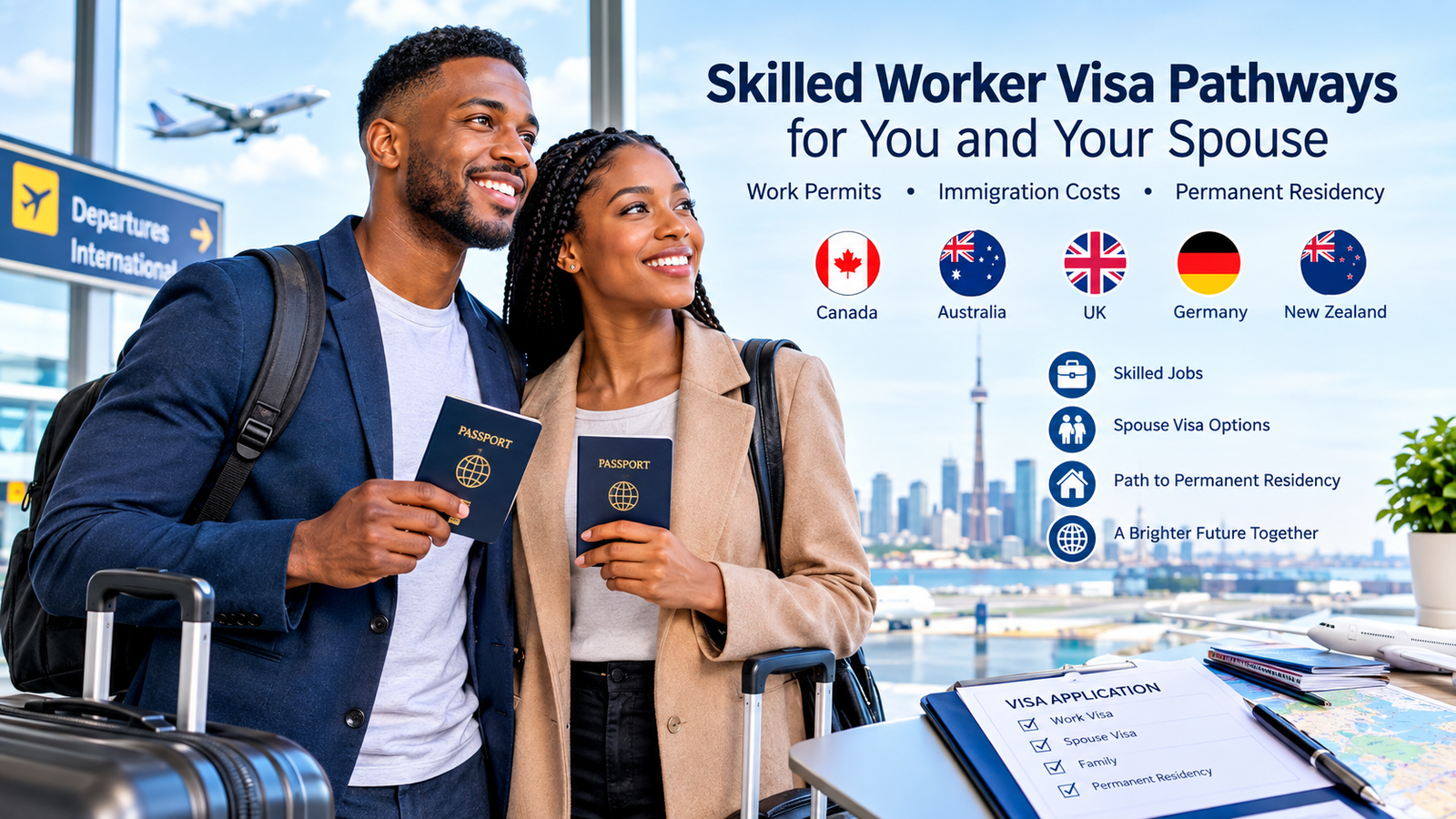
Discover top Countries With Skilled Worker Visa Sponsorship for You and Your Spouse in 2026. Explore work permits, visa costs, and fast-track pathways to permanent residency today!
Finding top Countries With Skilled Worker Visa Sponsorship for You and Your Spouse in 2026 is the key to securing a successful career move and a comfortable life abroad together. Moving to a new country with full legal employment rights for both partners significantly reduces financial stress and accelerates your path to long-term stability. In this guide, we break down the leading destinations offering skilled worker visa sponsorship for you and your spouse in 2026, covering essential work permit requirements, expected immigration costs, and direct routes to permanent residency.
If you’re a skilled professional planning to work abroad with your spouse in 2026, choosing the right immigration destination involves more than finding a job with a high salary. You also need to understand whether employers can sponsor your work visa, whether your spouse can accompany you, how much the immigration process costs, and whether the country offers a realistic pathway to permanent residency.
For international professionals, including applicants from Africa, Asia, and other regions, skilled worker immigration can provide opportunities to access international employment, develop professional experience, and establish a long-term future overseas. However, eligibility requirements, spouse work rights, visa fees, and settlement pathways vary significantly between countries.
This guide examines skilled worker visa sponsorship and accompanying-spouse immigration considerations in selected destinations. It focuses on official government immigration information, transparent cost categories, and practical steps for applicants evaluating international career opportunities.
Important: Immigration requirements and fees can change. The information below is intended for educational purposes, and applicants should verify current requirements through the relevant official government websites before submitting an application or making financial commitments.
Table of Contents
- What skilled worker visa sponsorship means in 2026
- What to check before applying with your spouse
- United Kingdom: Skilled Worker visa and dependant options
- Germany: EU Blue Card and family reunification
- Canada: Skilled immigration, work permits, and permanent residency
- Immigration costs and financial planning
- How to find legitimate visa sponsorship jobs
- Permanent residency: What applicants should understand
- Common mistakes that can delay an application
- Step-by-step application strategy
- Frequently asked questions
- Conclusion and author box
1. What Does Skilled Worker Visa Sponsorship Mean in 2026?
Skilled worker visa sponsorship generally refers to an immigration arrangement in which an eligible employer offers a job to a foreign national and meets the requirements to sponsor that person’s employment under the relevant immigration system.
The exact process depends on the destination country. Some countries require a specific employer sponsorship certificate, while others offer points-based immigration programs in which an applicant may qualify for permanent residence without first having an employer sponsor them.
For a married professional, the immigration decision has two connected parts:
- Employment eligibility: Can you legally qualify for a work visa or skilled immigration program?
- Family eligibility: Can your spouse accompany you, obtain permission to work, and eventually qualify for permanent residence?
A job offer alone does not guarantee visa approval. Immigration authorities may assess qualifications, salary, professional experience, language ability, admissibility, financial circumstances, and the authenticity of the employment arrangement.
Why spouse-friendly immigration matters
Relocating internationally as a couple can create additional expenses, including housing, transportation, health insurance, document certification, and the cost of applying for dependent visas. A destination that permits a spouse to work may also affect household income and career planning.
Before accepting an overseas job offer, applicants should investigate the actual conditions of the relevant immigration route rather than relying on recruitment advertisements that promise guaranteed approval.
2. What to Check Before Applying With Your Spouse
A successful immigration plan requires more than identifying countries with high salaries. You should examine the following areas before paying application fees or signing an employment agreement.
1. Employer sponsorship eligibility
Confirm whether the employer is authorized to sponsor foreign workers and whether the position qualifies under the relevant visa category.
2. Spouse work rights
Determine whether your spouse can work, whether they need a separate permit, and whether any occupational restrictions apply.
3. Total immigration expenses
Include application fees for both adults, health-related charges, document costs, travel, and initial settlement funds.
4. Long-term residency options
Check whether the work visa leads to a settlement permit or whether you will need to transition to a separate permanent residency program.
A note about advertised salary and real household income
A high annual salary does not necessarily translate into high disposable income. Taxes, rent, childcare, transport, insurance, and relocation expenses can significantly affect your budget.
When comparing destinations, assess the expected net household income and the costs of living in the specific city where you plan to work.
3. United Kingdom: Skilled Worker Visa and Dependant Options

The United Kingdom is a significant destination for internationally trained professionals seeking employer-sponsored employment. The Skilled Worker visa is designed for eligible jobs with approved Home Office sponsors.
According to the UK’s official immigration rules, the route requires a qualifying job with an approved sponsor and is a route to settlement. Applicants should verify the applicable occupation, salary, and sponsorship requirements before applying.

Who may qualify for the UK Skilled Worker visa?
Applicants generally need to satisfy the applicable requirements for:
- A job offer from a Home Office-approved sponsor.
- An eligible occupation.
- The required salary under the relevant immigration rules.
- English-language eligibility, subject to applicable exemptions.
- A valid Certificate of Sponsorship.
- Financial and suitability requirements.
The exact salary threshold depends on the occupation, the relevant rules, and any applicable exceptions or discounts. Therefore, candidates should not assume that every skilled occupation qualifies at the same salary.
Can your spouse join you in the UK?
Eligible spouses and partners may apply as dependants, but the rules contain important restrictions for certain occupations and immigration circumstances.
The official UK government guidance states that a dependant partner must generally demonstrate a qualifying relationship, such as a recognized marriage, civil partnership, or qualifying unmarried partnership. Some Skilled Worker occupation categories have additional restrictions on bringing dependants.
+1
A spouse’s application is separate from the main applicant’s application. Each applicant must meet the applicable requirements and pay the relevant fees.
Can your spouse work in the UK?
Under the general dependant conditions described by the UK government, an eligible dependant partner may work, including self-employment and voluntary work, except as a professional sportsperson or sports coach. The exact permission should be confirmed from the spouse’s immigration grant.
+1
This can be relevant for families that want to maintain two professional incomes after relocation. However, the availability of dependant status must be established before relying on this option, particularly if the sponsored worker is employed in a restricted occupation.
UK Skilled Worker visa costs
The UK government lists standard Skilled Worker application fees for applications made outside the UK as:
|
Application period
|
Standard fee per person
|
| — | — |
|
Up to 3 years
|
£819
|
|
More than 3 years
|
£1,618
|
The government also publishes reduced fees for certain qualifying jobs on the Immigration Salary List. These figures are application-fee categories and do not represent the full cost of relocation.
Immigration Health Surcharge
The UK generally charges an Immigration Health Surcharge for eligible visa applicants. The standard rate listed in the official guidance is £1,035 per year, although exemptions and different arrangements may apply depending on the visa category.
For a family application, calculate the likely charge for each person and the entire visa period. Check the official fee calculator before making a payment because the final amount depends on the application details.
Financial maintenance requirements
The UK government states that a Skilled Worker applicant will usually need £1,270 in available funds unless an exemption applies, such as qualifying employer certification of maintenance. Additional funds may be required for dependants, including £285 for a partner, £315 for the first child, and £200 for each additional child under the stated rules.
+1
UK permanent residency pathway
The Skilled Worker route is a route to settlement, but settlement is not automatic. Applicants must meet the relevant continuous residence, English-language, Life in the UK, salary, sponsorship, and other requirements in force when they apply.
The UK immigration rules provide for settlement requirements for Skilled Workers and their eligible dependants. Because immigration policy can change, applicants should consult the current official settlement guidance before planning their long-term timeline.
Official source: UK Skilled Worker visa — GOV.UK
4. Germany: EU Blue Card and Family Reunification
Germany offers immigration routes for qualified professionals, including the EU Blue Card. This option is particularly relevant to eligible professionals with recognized qualifications and an employment offer that meets the applicable conditions.
The official Make it in Germany portal publishes information on the EU Blue Card, salary thresholds, family reunification, and settlement permits. Applicants should use the applicable government information for their occupation and nationality.
+1
Germany EU Blue Card eligibility
The 2026 information published by the official German immigration portal identifies salary thresholds for the EU Blue Card, including:
|
Category
|
Gross annual salary threshold
|
| — | — |
|
General threshold
|
€50,700
|
|
Eligible shortage occupations
|
€45,934.20
|
The lower threshold applies to qualifying occupations and conditions. The official source also identifies eligible STEM-related professions, healthcare roles, and other shortage occupations.
+1
Applicants should verify the exact salary threshold, job classification, and qualification requirements before relying on an advertised position.
Can your spouse join you in Germany?
Germany permits family reunification for eligible skilled workers, including people holding qualifying residence titles such as the EU Blue Card.
The official Make it in Germany guidance states that spouses joining certain third-country skilled workers must meet applicable conditions, including the relevant residence title, health insurance, financial requirements where applicable, and age requirements. It also states that no German-language proof is required for family members joining a skilled worker with a valid residence title under the described conditions.
The specific procedure can depend on the residence status of the principal applicant and the nationality of the spouse. Applicants should confirm documentation requirements with the German mission responsible for their application.
Can your spouse work in Germany?
Family members joining an eligible skilled worker may receive residence permission that allows employment. The applicable work rights depend on the immigration status granted and the governing conditions.
Applicants should obtain confirmation of the spouse’s employment permission rather than assuming that all family members receive identical rights under every immigration category.
Germany immigration costs
Germany’s Federal Foreign Office identifies the normal fee for a national visa for longer stays as €75, subject to applicable waivers or reductions.
The European Commission’s EU Immigration Portal also lists a €100 initial EU Blue Card fee in Germany. Local residence permit costs, document translation, travel, and other expenses should be considered separately.
Actual expenses can vary according to the application location, type of residence permit, and services required.
Germany permanent residency options
Germany has a settlement permit system for eligible skilled workers. The official government portal explains that EU Blue Card holders may qualify under facilitated conditions after a specified period of qualified employment.
The settlement timeline described by the official source is:
- 27 months of qualified employment with the required pension contributions and German language level A1.
- 21 months where the applicant meets the German language level B1 requirement.
Applicants must satisfy other requirements, including financial self-sufficiency and applicable legal and administrative conditions.
+1
Practical considerations for professionals
Germany may require applicants to evaluate qualification recognition, professional licensing, employment conditions, and German-language requirements where applicable. A qualification or job title that appears suitable in a recruitment advertisement does not automatically establish eligibility for a particular residence permit.
Official sources:
- EU Blue Card — Make it in Germany
- Spouse family reunification — Make it in Germany
5. Canada: Skilled Immigration, Work Permits, and Permanent Residency

Canada offers several immigration pathways for foreign professionals, including employer-specific work permits and economic immigration programs. Unlike a conventional employer-sponsored route, some Canadian permanent residence programs assess candidates through points-based or selection systems.
This distinction matters because a person seeking to relocate with a spouse may be eligible for a work permit, permanent residence, or both through different processes.
Federal Skilled Worker Program
The Federal Skilled Worker Program is part of Canada’s Express Entry system. The official Canadian government explains that applicants must meet the applicable eligibility requirements and be admissible to Canada.
Applicants who intend to settle through the Federal Skilled Worker Program must plan to live outside Quebec because Quebec selects its own skilled workers under its separate system.
Eligibility can involve factors such as:
- Skilled work experience.
- Language proficiency.
- Education.
- Selection criteria.
- Admissibility.
- Settlement funds, unless an applicable exemption applies.
The Canadian government states that proof of funds is generally required for applicants in the Federal Skilled Worker Program, with exceptions including certain candidates who are legally able to work in Canada and have a valid job offer.
Can your spouse accompany you?
The family arrangements available to a principal applicant depend on the immigration program and the spouse’s eligibility. Canada distinguishes between permanent residence applications and temporary work permit applications.
A spouse’s ability to obtain a work permit should be checked under the current eligibility rules for the specific principal applicant’s permit and occupation. Applicants should avoid treating all Canadian work permits as automatically providing identical spouse work rights.
Canada immigration costs
Canadian immigration expenses vary according to the program and the number of applicants. Fees may include:
- Work permit or permanent residence application fees.
- Biometrics fees where applicable.
- Right of Permanent Residence Fee, where applicable.
- Medical examination expenses.
- Police certificates.
- Language testing.
- Educational credential assessment.
- Translation and document certification.
Canada’s official fee information records a permanent residence fee increase effective April 30, 2026. The listed new fees include a principal applicant processing fee of CAD 990 for Federal High Skilled and several other economic immigration programs, and a Right of Permanent Residence Fee of CAD 600 for the principal applicant and accompanying spouse or common-law partner.
These amounts should not be interpreted as a complete family immigration budget. Applicants must confirm the current fee schedule and determine which charges apply to their individual application.
Canada permanent residency
Canada’s Express Entry system includes economic immigration programs that may lead directly to permanent residence when the applicant receives an invitation and meets all relevant requirements.
A valid job offer can be relevant in some immigration contexts, but it does not by itself guarantee an invitation or permanent residence. Candidates should examine the official program criteria and current selection requirements before making a financial or employment decision.
Official source: Immigration and citizenship — Government of Canada
6. Immigration Costs: How to Build a Realistic Family Budget
One of the most common mistakes international applicants make is calculating only the visa application fee. The actual cost of moving abroad with a spouse can be substantially higher.
A responsible immigration budget should include both government charges and personal expenses.
Main expenses to include
|
Expense category
|
What to consider
|
| — | — |
|
Visa application fees
|
Principal applicant and spouse’s fees
|
|
Health-related charges
|
Health surcharge, insurance, or medical examination
|
|
Biometrics
|
Where required by the immigration system
|
|
Language tests
|
English, German, French, or other applicable tests
|
|
Document preparation
|
Translations, certification, police certificates
|
|
Travel
|
Flights, local transport, and airport expenses
|
|
Housing
|
Deposit, initial rent, and temporary accommodation
|
|
Settlement funds
|
Money needed before receiving your first salary
|
|
Professional services
|
Optional regulated immigration advice or legal assistance
|
Why you should avoid relying on a single advertised cost
Recruitment companies and online immigration advertisements sometimes display an attractive headline fee without explaining additional charges. This can make an offer look less expensive than it is.
Before transferring money, request a written breakdown of:
- Government application fees.
- Employer-paid sponsorship expenses, if applicable.
- Costs the applicant is expected to pay.
- Whether spouse applications are included.
- Any refundable and non-refundable charges.
- The service provider’s legal identity and registration details.
A genuine job offer should not require you to ignore official immigration requirements. Be especially cautious if a recruiter promises guaranteed visa approval, asks for payment to an unverified personal account, or refuses to provide an employment contract.
7. How to Find Legitimate Skilled Worker Visa Sponsorship Jobs
Finding an eligible employer is often more challenging than identifying an immigration destination. A candidate may have the right qualifications but still need an employer offering a suitable position and complying with the relevant sponsorship rules.
Step 1: Identify occupations that match your experience
Start by defining your professional profile:
- Academic qualifications.
- Years of relevant experience.
- Industry certifications.
- Language proficiency.
- Professional registration, where required.
- Current job responsibilities.
For example, an IT professional may investigate software development, cloud engineering, cybersecurity, or data-related roles. A healthcare professional may need to assess licensing and professional registration in addition to visa eligibility.
Step 2: Check the official occupation and eligibility rules
Job titles are not always sufficient to establish eligibility. The responsibilities, salary, qualification requirements, and classification of the position may determine whether it qualifies under a specific immigration route.
Use official government immigration websites to verify the route before assuming that an employer’s job description is eligible.
Step 3: Search for employers through reliable channels
You can explore:
- Official government employment portals.
- Established job boards.
- Company career pages.
- Professional networking platforms.
- Industry recruitment agencies.
When reviewing a job listing, look for the employer’s legal name, location, role responsibilities, salary, employment conditions, and sponsorship information.
Step 4: Ask specific questions before accepting an offer
Consider asking the employer:
Does your company currently sponsor eligible international applicants for this position, and which immigration route would apply to the employment contract?
Also ask whether the employer will cover any sponsorship-related costs and whether your spouse’s immigration application is your responsibility.
Employers may not be required to pay every expense associated with an employee’s relocation or family applications. The agreement should be clear and documented.
8. Permanent Residency: What Skilled Workers Should Understand
Permanent residency, settlement, or a similar long-term residence status can offer greater stability than a temporary work visa. However, each country defines its own requirements, and eligibility is not guaranteed simply because you have worked there for several years.
Common requirements across immigration systems
Depending on the country and route, applicants may need to demonstrate:
- A minimum qualifying period of residence.
- Compliance with immigration conditions.
- Continued employment or another qualifying basis.
- Language proficiency.
- Financial self-sufficiency.
- Good character or admissibility.
- Payment of required taxes or social contributions, where applicable.
UK settlement
The UK Skilled Worker route is a route to settlement. However, applicants must meet the applicable settlement requirements, including relevant residence and other eligibility conditions. The rules in force at the time of application are important.
Germany settlement permit
Germany provides settlement permit options for eligible skilled workers, including facilitated conditions for qualifying EU Blue Card holders. The official government portal describes the relevant employment duration and language requirements.
Make it in Germany
+1
Canada permanent residence
Canada has economic immigration programs through which eligible applicants may receive permanent residence. The applicable program requirements and selection procedures must be satisfied, and an applicant should not assume that a temporary work permit automatically converts into permanent residence.
Why policy changes matter
Immigration legislation and administrative policies can change during the period between your initial application and your permanent residency application. Salary thresholds, settlement requirements, family eligibility, and application fees may be amended.
A practical approach is to review the relevant official immigration website at each major stage:
- Before applying for employment.
- Before submitting the visa application.
- Before extending your work permit.
- Before applying for permanent residence.
9. Common Mistakes That Can Delay a Visa Application
Even a qualified applicant can experience delays if documents are incomplete or information is inconsistent.
Mistake 1: Applying for a visa that does not match the job
A professional may qualify for one immigration route but not another. Review the job classification and route-specific conditions before selecting an application category.
Mistake 2: Assuming that every spouse receives work rights
Spouse immigration conditions vary. Confirm whether your spouse receives work authorization automatically, needs a separate permit, or faces restrictions.
Mistake 3: Ignoring professional licensing
Certain professions, including regulated healthcare and technical roles, may require registration or authorization before employment can begin.
A visa approval is not necessarily a professional licence.
Mistake 4: Underestimating settlement costs
Applicants sometimes budget for the application but overlook rent deposits, temporary accommodation, transportation, and the period before receiving their first salary.
Mistake 5: Paying unverified immigration intermediaries
Use official government information to understand the application process and confirm whether an immigration adviser is appropriately authorized where professional advice is required.
Mistake 6: Using outdated immigration information
A blog article, social media video, or recruitment advertisement may contain historical information. Check the date of official government guidance and verify requirements at the time of application.
10. Step-by-Step Application Strategy for Skilled Workers and Their Spouses
A structured process can help applicants identify missing documents and avoid unnecessary expenses.
- Evaluate your professional eligibilityReview your qualifications, experience, occupation, salary expectations, and language ability.
- Choose a suitable country and immigration routeCompare the relevant visa requirements, family options, and long-term residency conditions.
- Secure a qualifying employment offerConfirm the employer’s identity, job responsibilities, salary, and sponsorship arrangements.
- Verify spouse eligibilityReview the rules for marriage documentation, dependent status, work permission, and any restrictions.
- Calculate the total budgetInclude official fees, documentation, medical expenses, travel, and initial settlement funds.
- Prepare and submit accurate applicationsFollow the relevant government process and ensure that information is complete and consistent.
- Plan for arrival and long-term residencePrepare for housing, employment commencement, healthcare arrangements, and future residence requirements.
11. Frequently Asked Questions
1. Can I apply for a skilled worker visa with my spouse at the same time?
In some immigration systems, eligible spouses can submit their applications alongside the main applicant. In others, the spouse may apply later or follow a separate family immigration process.
The precise procedure depends on the country, the visa category, and the relationship requirements. For example, the UK provides separate dependant application processes for eligible family members.
2. Does an employer-sponsored job guarantee permanent residency?
No. A work visa and permanent residency are separate immigration outcomes. Some routes provide a direct or structured pathway to settlement, while others require a separate application and additional eligibility criteria.
Applicants should examine the permanent residency requirements before selecting a temporary work route.
3. Can my spouse work after relocating?
In some countries and visa categories, an eligible spouse may have permission to work. The scope of that permission varies and may depend on the principal applicant’s occupation, residence status, and applicable regulations.
Verify the specific conditions before planning your household finances around a spouse’s expected employment.
4. What documents should a married applicant prepare?
Typical documents may include:
- Valid passports.
- Employment contract or job offer.
- Qualification certificates.
- Proof of professional experience.
- Marriage certificate.
- Language test results, where required.
- Police certificates, where applicable.
- Medical documents, where required.
- Financial evidence.
- Certified translations when requested.
This is a general planning list, not a universal checklist. The official immigration authority determines which documents are required for each route.
5. Should I use an immigration lawyer or consultant?
Professional immigration advice may be useful for applicants with complex circumstances, regulated professions, prior immigration issues, or questions about family eligibility.
However, an adviser cannot guarantee a visa approval. Check the applicable professional authorization requirements and obtain clear written information about service fees before hiring someone.
6. How can I confirm the latest visa fees?
Use the official immigration authority for the destination country. Review the fee schedule, application category, number of applicants, and any additional charges that apply to your circumstances.
Do not rely exclusively on older articles, screenshots, or informal social media posts.
12. Conclusion: Plan Your International Career and Family Relocation Carefully
Skilled worker immigration can offer a route to international employment and, in qualifying cases, long-term residence. However, the right destination depends on the applicant’s professional qualifications, employment opportunity, family circumstances, financial resources, and long-term goals.
The United Kingdom, Germany, and Canada each have distinct immigration systems. The UK Skilled Worker route supports eligible sponsored employment and may lead to settlement. Germany’s EU Blue Card provides a route for qualifying highly skilled professionals, with family reunification and facilitated settlement provisions under the relevant rules. Canada offers economic immigration pathways, including Express Entry programs, alongside separate work permit arrangements.
For married applicants, the spouse’s immigration rights should be considered from the beginning rather than treated as an afterthought. Review official eligibility requirements, confirm costs, and avoid making financial commitments based on promises of guaranteed employment or visa approval.
The most useful next step is to select an immigration route that matches your qualifications and verify the applicable requirements directly through the official government source.
Official Immigration Resources
Use these government resources to confirm current eligibility rules, fees, and application procedures.
United Kingdom
Skilled Worker visa, dependant applications, and settlement requirements.
Germany
EU Blue Card, family reunification, and settlement permits.
Canada
Express Entry, skilled worker immigration, and application fees.
Author Box
Dynamo Gills
Writer & Researcher at Biodynasty
Research
Career Opportunities
Immigration Information
Dynamo Gills is a writer and researcher at Biodynasty, creating practical, reader-focused content on international career opportunities, education, and immigration information. This article is intended to help readers understand skilled worker visa pathways, family considerations, and official government resources.
Editorial note: Immigration rules, eligibility criteria, and government fees can change. Readers should consult the relevant official immigration authority for current requirements before making an application or financial commitment.

 Dynamo