 Dynamo
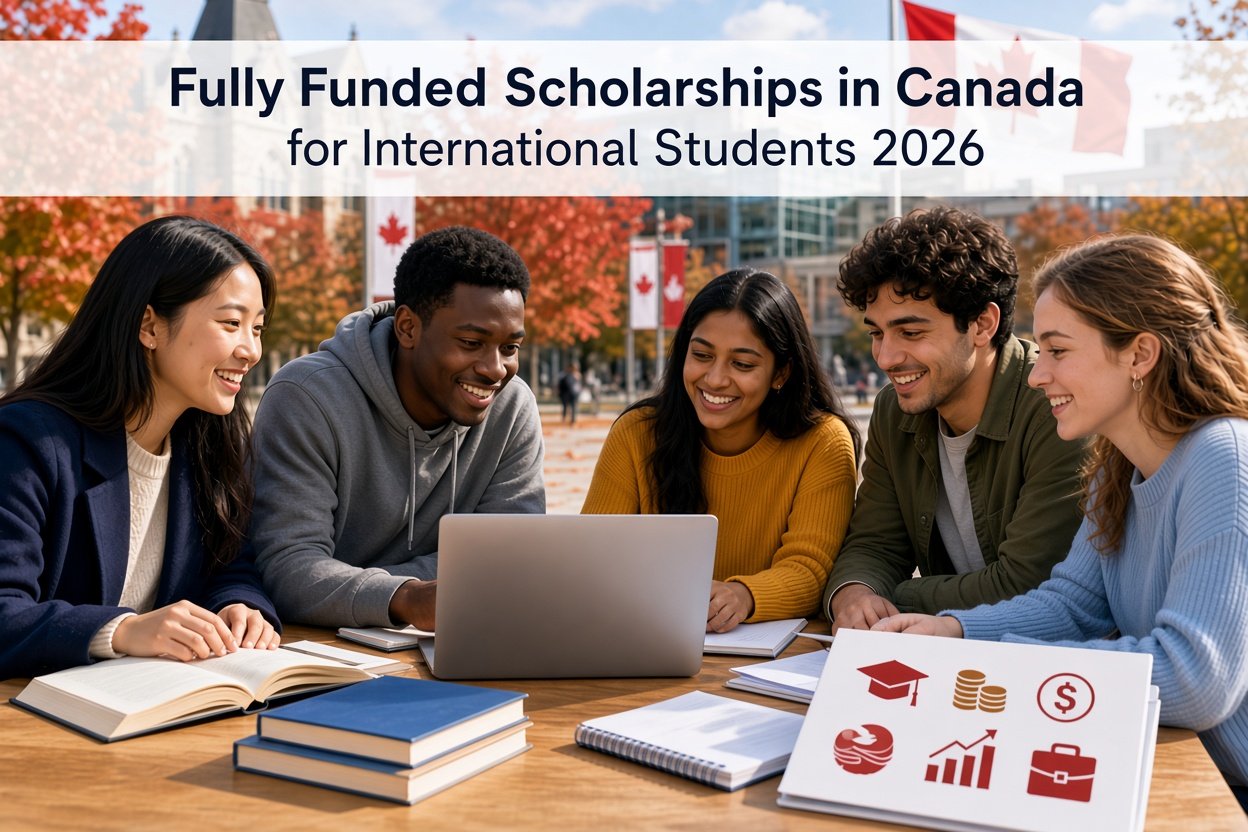
Explore fully funded scholarships in Canada for international students 2026, including tuition funding, living expenses, study permit requirements and post-graduation work options.
Finding a way to finance an international degree can be one of the biggest challenges for students planning to study abroad. Fully funded scholarships in Canada for international students 2026 can significantly reduce that financial burden by covering some or, in the most comprehensive awards, most of the major costs associated with studying in Canada.
Canada remains an attractive destination for international students because it combines globally recognized universities, research opportunities, multicultural communities and pathways that may allow eligible graduates to gain Canadian work experience after completing their studies.
However, prospective students should understand an important distinction: not every scholarship advertised as “fully funded” pays every expense. Some scholarships cover tuition only, while others may provide a living allowance, accommodation support, travel funding, health insurance or research expenses.
The Canadian government’s EduCanada platform confirms that international students can find scholarship, fellowship and grant opportunities through the Government of Canada, provinces and territories, and Canadian educational institutions.
This guide explains how to find fully funded scholarships in Canada for international students 2026, what funding may cover, how scholarships interact with the Canadian study permit process, how much money students may still need to demonstrate, and what to know about post-graduation work options.
Table of Contents
- What Are Fully Funded Scholarships in Canada?
- What Can a Canadian Scholarship Cover?
- Types of Scholarships Available to International Students
- Where to Find Fully Funded Scholarships in Canada for International Students 2026
- Government of Canada Scholarship Opportunities
- Canadian University Scholarships for International Students
- Graduate and Research Funding
- Canada Study Permit Requirements for Scholarship Students
- Proof of Financial Support in 2026
- Do Scholarship Recipients Still Need a Study Permit?
- Provincial Attestation Letter Requirements
- Post-Graduation Work Permit Options
- How to Choose a Scholarship and Canadian Program
- How to Apply Successfully
- Common Scholarship Mistakes to Avoid
- Frequently Asked Questions
- Final Thoughts
1. What Are Fully Funded Scholarships in Canada?
A fully funded scholarship generally refers to an award designed to cover a substantial portion of the total cost of studying, rather than simply reducing tuition.
Depending on the scholarship, funding may include:
- Full or partial tuition fees
- Monthly living allowance
- Accommodation support
- Books and academic materials
- Research expenses
- Health insurance
- Travel or airfare allowances
- Conference or professional development funding
- Relocation support
The exact package varies considerably.
For example, a scholarship might cover the full tuition fee but provide no money for accommodation or food. Another award may provide tuition plus a monthly stipend but require the student to pay travel expenses.
This distinction is important when searching for fully funded scholarships in Canada for international students 2026.
Before accepting an award, applicants should carefully review the scholarship’s official terms and determine exactly which expenses are covered.
2. What Can a Canadian Scholarship Cover?
Canadian scholarships can have very different financial structures.
Tuition funding
Tuition is often the largest academic expense for international students. EduCanada reports that average university tuition for international undergraduate students is substantially higher than for domestic students, while graduate tuition is generally lower on average.
A scholarship that covers tuition can therefore represent a significant reduction in the cost of an international education.
Living expenses
Some comprehensive scholarships provide a stipend to help pay for:
- Rent
- Food
- Transportation
- Internet
- Personal expenses
- Study materials
However, students should not assume that a scholarship automatically covers all living expenses.
Research funding
Graduate students may receive scholarships or research awards that include funding for laboratory work, field research, conferences or other academic activities.
Travel funding
Certain international scholarship programs may include transportation or travel allowances. This is particularly common with government-sponsored exchange and research programs.
The key is to read the official funding package instead of relying on the phrase “fully funded.”
3. Types of Scholarships Available to International Students
There are several major categories of Canadian scholarship funding.
University entrance scholarships
Universities may offer scholarships to international students entering undergraduate programs.
These awards can be based on:
- Academic performance
- Leadership
- Community involvement
- Extracurricular achievements
- Athletic performance
- Financial need
- Specific academic programs
Some are automatic consideration awards, while others require separate applications.
Graduate scholarships
Master’s and doctoral students can access scholarships and research funding through universities, government programs and research institutions.
Graduate funding can be particularly valuable because many awards are structured around research projects and may include a stipend.
Government-funded international scholarships
The Government of Canada and Global Affairs Canada administer international scholarship and exchange programs for eligible applicants from selected countries.
The official EduCanada scholarship database is one of the most useful starting points because applicants can search opportunities based on citizenship, profile and country or territory.
Institutional scholarships
Individual Canadian universities and colleges may offer scholarships, fellowships, bursaries and assistantships.
These awards can differ dramatically from one institution to another.
4. Where to Find Fully Funded Scholarships in Canada for International Students 2026
The safest approach is to begin with official scholarship databases rather than relying on social media posts or websites promising guaranteed awards.
The Government of Canada’s EduCanada platform provides a dedicated scholarship search tool for international applicants.
Applicants can use it to investigate available opportunities and determine whether they meet the eligibility requirements.
A good scholarship search should consider:
- Your nationality
- Academic level
- Intended field of study
- Degree type
- Research interests
- Scholarship closing date
- Language requirements
- Admission requirements
- Funding duration
- Eligible institutions
The official scholarship description should always be treated as the final authority.
5. Government of Canada Scholarship Opportunities
The Canadian government maintains information on scholarship programs for international students and Canadian scholars.
The official international scholarship system includes opportunities for students, researchers and institutions.
Some programs focus on short-term study or research rather than a complete undergraduate or graduate degree.
For example, EduCanada lists programs such as the Study in Canada Scholarships, which provide opportunities for eligible students from selected countries and territories to undertake short-term study or research in Canada.
There are also international scholarship opportunities connected to particular regions and academic objectives.
This means applicants should not assume that every Government of Canada scholarship is a four-year fully funded degree.
Instead, check:
- Eligible countries
- Eligible academic levels
- Duration
- Eligible institutions
- Allowable expenses
- Application method
- Deadline
- Whether students apply directly or through their institution
The official scholarship database should be checked regularly because programs, deadlines and eligibility requirements can change.
6. Canadian University Scholarships for International Students
Canadian universities are another major source of scholarship funding.
Many institutions offer international student awards at the undergraduate and graduate levels.
University scholarships can include:
Entrance scholarships
These are generally intended for students beginning a new program.
Merit scholarships
These recognize strong academic achievement or exceptional accomplishments.
International student awards
Some universities establish dedicated funding for students from outside Canada.
Graduate fellowships
These may provide tuition assistance, research funding or living stipends.
Teaching and research assistantships
Graduate students may sometimes receive financial support through teaching or research positions, depending on the institution and program.
Students should search the official funding page of every university they are considering.
Do not rely on a general scholarship website when the university itself provides the official award conditions.
7. Graduate and Research Funding
Students pursuing master’s and doctoral degrees should pay particular attention to research-based funding.
Research funding can be available through:
- Universities
- Research supervisors
- Government programs
- Research councils
- International scholarship programs
- Faculty-level awards
- External foundations
Applicants should investigate the funding structure before submitting an application.
For research-intensive programs, contacting potential supervisors can also be important because some research positions depend on available project funding.
A strong academic profile may include:
- High grades
- Research experience
- Publications
- Conference participation
- Strong references
- Relevant professional experience
- A clear research proposal
However, every scholarship has its own selection criteria.
8. Canada Study Permit Requirements for Scholarship Students
Receiving a scholarship does not automatically mean that an international student can enter Canada without immigration authorization.
Students who need a study permit generally must meet Canada’s study permit requirements.
Applicants normally need:
- A letter of acceptance from a designated learning institution
- Proof of identity
- Proof of financial support
- Required provincial or territorial documentation, unless exempt
- Biometrics where required
- Additional documents depending on the applicant’s circumstances
Canadian immigration authorities state that applicants must demonstrate sufficient financial resources for tuition, living expenses and transportation.
The applicant must also satisfy other eligibility and admissibility requirements.
This is why scholarship applicants should consider the immigration process at the same time as the university application.
9. Proof of Financial Support in 2026
One of the most important changes applicants should understand is that receiving a scholarship does not necessarily eliminate the requirement to demonstrate financial capacity.
As of applications made on or after September 1, 2026, IRCC lists the living-expense requirement for one student outside Quebec at CAD $23,448 per year, excluding tuition and transportation.
The amount increases when family members accompany the applicant.
For example, IRCC lists the following annual living-expense amounts for applications made on or after September 1, 2026:
| Family members including applicant | Required living expenses |
|---|---|
| 1 | CAD $23,448 |
| 2 | CAD $29,192 |
| 3 | CAD $35,888 |
| 4 | CAD $43,572 |
| 5 | CAD $49,419 |
| 6 | CAD $55,736 |
| 7 | CAD $62,054 |
Each additional family member above seven adds another specified amount.
These figures exclude tuition and transportation.
A scholarship can therefore be extremely helpful, but students should understand exactly what their award covers.
If the scholarship covers tuition but does not provide living expenses, the student may still need to demonstrate funds for accommodation, food, transportation and other eligible expenses.
Acceptable evidence may include scholarship documentation, bank statements, education loans and other qualifying financial documents.
10. Do Scholarship Recipients Still Need a Study Permit?
In many cases, yes.
A scholarship is financial support. A study permit is immigration authorization to study in Canada.
They serve different purposes.
A scholarship does not replace the study permit application.
Students should therefore plan two connected processes:
Academic process
Scholarship application → University admission → Letter of acceptance
Immigration process
Letter of acceptance → Required documentation → Study permit application → Biometrics and assessment → Travel authorization
Keeping these processes separate can help prevent confusion.
Students should always use the current Immigration, Refugees and Citizenship Canada requirements rather than relying on information from old scholarship articles.
11. Provincial Attestation Letter Requirements
The Provincial Attestation Letter or Territorial Attestation Letter, commonly called a PAL/TAL, is another important consideration.
In most cases, international students need a PAL/TAL when applying for a Canadian study permit.
However, there are important exemptions.
For 2026, students entering degree-granting master’s or doctoral programs at public designated learning institutions generally do not need a PAL/TAL.
This exemption took effect January 1, 2026.
Students planning to study in Quebec should pay particular attention to Quebec’s separate requirements, including the Quebec Acceptance Certificate where applicable.
Because PAL/TAL rules can vary according to program and circumstances, applicants should verify their individual situation before submitting an immigration application.
12. Post-Graduation Work Permit Options
One of the reasons students consider Canada is the possibility of gaining Canadian work experience after graduation.
However, graduation from a Canadian institution does not automatically guarantee a post-graduation work permit.
The program and institution must satisfy the applicable eligibility requirements.
IRCC states that, generally, a student must have completed an eligible program at a PGWP-eligible designated learning institution and meet the relevant study, language and other requirements.
For many graduates, the current rules also include language requirements.
For graduates with bachelor’s, master’s or doctoral degrees, IRCC currently specifies a minimum Canadian Language Benchmark or Niveaux de compétence linguistique canadiens level of 7 in English or French in all four language areas.
For certain other university, college and non-university programs, different language and field-of-study rules can apply.
This makes it essential to check PGWP eligibility before choosing a program, not after graduation.
Why PGWP eligibility matters when choosing a scholarship
A student may find an attractive scholarship but discover that the associated program does not provide the post-graduation work option they expected.
Therefore, students interested in working in Canada after graduation should investigate three things separately:
- Is the institution a designated learning institution?
- Is the specific program PGWP eligible?
- What PGWP rules apply to that program and the student’s study-permit application date?
The official DLI database identifies institutions and provides program-level information relevant to PGWP eligibility.
13. How to Choose a Scholarship and Canadian Program
The largest scholarship is not necessarily the best fit for every student.
Instead, compare the complete financial and academic package.
Compare tuition
Determine the actual international tuition fee for the program.
Calculate remaining expenses
Subtract the scholarship from tuition and then estimate:
- Housing
- Food
- Transportation
- Insurance
- Books
- Personal expenses
- Flights
- Immigration-related costs
Check scholarship duration
A scholarship may cover one academic year rather than the entire degree.
Review renewal conditions
Some awards require students to maintain a particular grade or academic standing.
Check work-permit eligibility
If post-graduation employment is part of your plan, verify PGWP eligibility before accepting the offer.
Consider program quality
The funding should not be the only consideration.
Look at:
- Curriculum
- Faculty
- Research opportunities
- Employment relevance
- Location
- Student services
- Housing availability
- Total cost of attendance
14. How to Apply Successfully
Competition for major scholarships can be intense.
A strong application usually starts months before the deadline.
Step 1: Build a scholarship list
Create a spreadsheet containing:
- Scholarship name
- University
- Degree level
- Eligibility
- Funding amount
- Deadline
- Required documents
- Application link
- Admission deadline
Step 2: Check eligibility first
Do not spend days preparing an application for a scholarship for which you are not eligible.
Step 3: Prepare academic documents
Depending on the program, you may need:
- Academic transcripts
- Certificates
- Curriculum vitae
- Recommendation letters
- Research proposal
- Statement of purpose
- Proof of language proficiency
Step 4: Write a specific personal statement
Avoid generic statements such as “Canada has a world-class education system.”
Instead, explain:
- What you want to study
- Why the program fits your goals
- What experience you already have
- What problem you want to solve
- How the scholarship would support your education
- What contribution you expect to make after your studies
Step 5: Check every document
Small administrative errors can create unnecessary problems.
Verify:
- Names
- Dates
- Academic records
- Passport information
- Recommendation letters
- Formatting
- Required signatures
- Submission deadlines
15. Common Scholarship Mistakes to Avoid
Mistake 1: Assuming every scholarship is completely funded
Always read the funding breakdown.
Mistake 2: Paying an unverified “scholarship agent”
Applicants should be cautious about organizations demanding large payments in exchange for guaranteed scholarships or guaranteed Canadian visas.
Legitimate scholarship programs publish eligibility criteria and application procedures.
Mistake 3: Ignoring immigration requirements
Admission and scholarship funding do not automatically guarantee study-permit approval.
Mistake 4: Choosing a program without checking PGWP eligibility
If post-graduation work matters to you, investigate eligibility before enrolling.
Mistake 5: Using outdated financial figures
Canadian immigration financial requirements can change.
Use current IRCC figures when preparing a study permit application.
Mistake 6: Submitting a generic personal statement
Scholarship committees need to understand why the applicant is a strong fit for that particular award.
16. Frequently Asked Questions
Can international students get fully funded scholarships in Canada in 2026?
Yes. International students can access scholarship, fellowship and grant opportunities in Canada, although availability depends on nationality, academic level, institution, program and individual eligibility.
Not every award covers every expense, so applicants should review the official funding terms.
Does a full scholarship cover the Canada study permit financial requirement?
Not necessarily.
If a scholarship covers tuition but not living expenses, applicants may need to provide additional evidence showing they can support themselves.
IRCC specifically recognizes proof of scholarship as one possible form of financial evidence, while noting that additional proof may be necessary depending on what the scholarship covers.
Do international students need a PAL/TAL in 2026?
Many students do, but exemptions exist.
For 2026, degree-granting master’s and doctoral students at public DLIs are generally exempt from the PAL/TAL requirement.
Other students should check the current IRCC rules for their specific program.
Can scholarship students work in Canada?
Eligible international students may be able to work while studying under Canada’s international student work rules.
However, working should not be treated as a substitute for demonstrating the required financial resources for a study permit.
Can I work in Canada after graduation?
Some graduates may qualify for a post-graduation work permit.
Eligibility depends on factors including the institution, program, study duration, language requirements and applicable field-of-study rules.
Graduation alone does not guarantee a PGWP.
What is the best place to search for Canadian scholarships?
The official EduCanada scholarship search tool is a useful starting point for international applicants.
Students should also search the official funding pages of universities and departments.
17. Final Thoughts
For students planning an international education, fully funded scholarships in Canada for international students 2026 can make a major difference to the overall cost of studying abroad.
The strongest approach is not simply to search for the largest advertised scholarship. Instead, applicants should evaluate the entire financial and immigration picture.
Start by identifying scholarships for which you are genuinely eligible. Then compare tuition coverage, living allowances, scholarship duration and renewal conditions.
At the same time, confirm that the institution is a designated learning institution, understand the current study permit requirements and determine whether a PAL/TAL is required.
If your long-term plan includes working in Canada after graduation, investigate PGWP eligibility before choosing your program. Current Canadian immigration rules make program-level eligibility increasingly important.
Finally, use official sources whenever possible. Scholarship requirements, study permit rules, financial requirements and work-permit policies can change, so information published several years ago may no longer accurately describe the 2026 application environment.
A well-researched scholarship strategy combines education funding, immigration compliance, career planning and realistic budgeting. That approach gives international applicants a much clearer picture of what it will actually take to study and build professional experience in Canada.
Official Canadian Resources
For the latest requirements and application instructions, applicants should verify information directly with:
- Immigration, Refugees and Citizenship Canada (IRCC)
- Government of Canada’s Designated Learning Institution database
- EduCanada’s international scholarship database
- The official website of the Canadian university offering the scholarship
Important: Scholarship availability, eligibility requirements, immigration rules, financial requirements and work-permit policies can change. Always confirm the current requirements before submitting an application or paying any fees.
Author Box
Dynamo Gills
Writer & Researcher at Biodynasty
Dynamo Gills is a writer and researcher covering international education, scholarships, immigration pathways, career opportunities and global study programs. His work focuses on making complex education and immigration information easier for prospective international students to understand, while encouraging readers to verify important requirements through official government and institutional sources.
Official links for reference:
- Canada study permit requirements: Official Canada study permit requirements
- Study permit application process: How to apply for a Canadian study permit
- 2026 proof of financial support: IRCC proof of financial support requirements
- 2026 PAL/TAL requirements: IRCC PAL/TAL requirements and exemptions
- Designated Learning Institutions: Official Canadian DLI list
- PGWP eligibility: Official PGWP eligibility requirements
- International scholarships: EduCanada international scholarship portal
- Scholarship search tool: Search Canadian scholarships for international applicants
- Canada international student work rules: Work in Canada as an international student

 Dynamo