 Dynamo
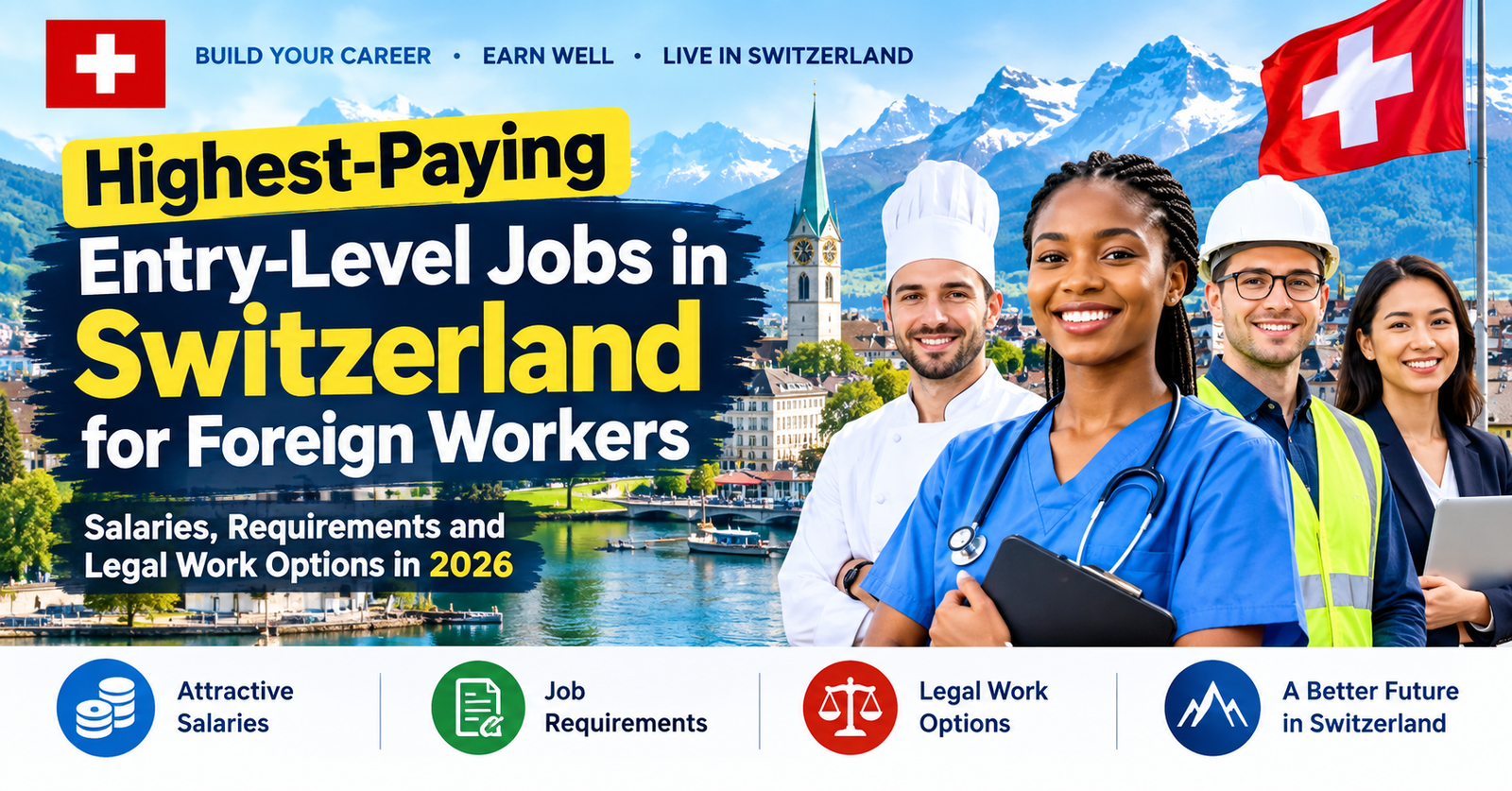
Discover the highest-paying entry-level jobs in Switzerland for foreign workers. Explore starting salaries, essential visa requirements, and legal work options.
Finding the highest-paying entry-level jobs in Switzerland for foreign workers is one of the most lucrative ways to launch an international career in 2026. Renowned for its high standard of living, competitive compensation, and booming multinational industries, Switzerland offers exceptional entry-level pay across sectors like technology, pharmaceuticals, finance, and engineering.
However, navigating the Swiss labor market as a foreign national requires a clear understanding of visa regulations, permit quotas, and local hiring constraints. This guide breaks down the top high-paying starter roles, gross salary expectations, candidate requirements, and legal pathways to help non-Swiss residents land a job and secure work authorization in Switzerland.
Switzerland is frequently associated with high wages, international companies and a strong standard of living. That makes the country appealing to people searching online for entry-level jobs, hospitality jobs, cleaning positions, logistics work and other employment opportunities abroad.
However, there is a major difference between finding a job advertisement and qualifying to work legally in Switzerland.
For EU/EFTA citizens, access to Swiss employment is generally easier under the applicable free-movement arrangements. For citizens of countries outside the EU/EFTA area, Switzerland has a much more selective labour-market admission system. The Swiss State Secretariat for Migration states that third-country nationals generally need to be highly qualified, and work permits are limited.
That means this article should not be interpreted as a promise that every entry-level vacancy is available to an overseas applicant.
Instead, it provides a practical overview of employment categories, salary considerations, qualifications, work authorization and safer job-search strategies.
What Is an Entry-Level Job in Switzerland?
An entry-level job is generally a position that does not require extensive professional experience or advanced credentials.
Examples may include:
- Cleaning assistant
- Hotel housekeeping worker
- Kitchen assistant
- Warehouse worker
- Production assistant
- Retail assistant
- Hospitality support worker
- Maintenance assistant
- Delivery support worker
- Administrative assistant
The actual requirements differ considerably.
Some positions labelled “entry-level” may still require previous experience, language skills or specific training.
Important Immigration Difference for Foreign Workers
A person may qualify for an entry-level job from an employment perspective but still not qualify for Swiss immigration.
This distinction is essential.
Swiss authorities explain that third-country nationals are generally admitted as highly qualified workers, while Swiss and EU/EFTA workers receive priority under the labour-market rules.
Consequently, applicants from outside Europe should not assume that an entry-level vacancy provides an easy immigration route.
1. Cleaning and Housekeeping Jobs
Cleaning remains one of the most visible entry-level employment categories.
Potential positions include:
- Hotel housekeeper
- Office cleaner
- Commercial cleaner
- Building cleaner
- Laundry assistant
- Public-area cleaner
- Industrial cleaning assistant
Duties may include:
- Cleaning floors
- Sanitising bathrooms
- Emptying waste
- Changing linen
- Cleaning public areas
- Maintaining supplies
- Following health and safety procedures
Salary considerations
Cleaning pay varies by canton, employer, contract and applicable collective employment agreement.
SECO maintains information on collective employment agreements affecting the Swiss cleaning sector.
Rather than relying on one online salary estimate, applicants should check the specific contract and applicable sector rules.
For 2026, Switzerland’s job-registration requirement includes cleaning staff and auxiliary staff in offices, hotels and other establishments.
For a detailed examination of cleaning employment specifically, see our companion guide:
2. Hotel and Hospitality Jobs
Switzerland has a substantial hospitality sector, particularly in cities, tourism centres and mountain destinations.
Entry-level hospitality positions can include:
- Housekeeping assistant
- Kitchen assistant
- Food-service worker
- Restaurant assistant
- Laundry worker
- Hotel public-area cleaner
- Guest-service assistant
Employers may value:
- Reliability
- Customer-service skills
- Language ability
- Flexibility
- Previous hospitality experience
Applicants should pay attention to whether accommodation is included.
Some hotels and seasonal employers may offer staff accommodation, but this varies by employer and location.
If you’re considering hotel and hospitality jobs in Switzerland or Germany, take a look at our guide to the top opportunities available to international workers. Top Hotel and Hospitality Jobs in Switzerland and Germany for International Workers: Visa Sponsorship Opportunities
3. Warehouse and Logistics Jobs
Warehouse and logistics work can include:
- Warehouse assistant
- Order picker
- Packing worker
- Inventory assistant
- Dispatch assistant
- Logistics support worker
Skills that may help include:
- Inventory management
- Basic computer use
- Forklift certification
- Safety awareness
- Physical stamina
- Attention to detail
Although these jobs may appear accessible, overseas applicants should still check whether the employer is able and willing to hire a worker requiring Swiss authorization.
4. Manufacturing and Production Jobs
Manufacturing companies may recruit workers for:
- Assembly
- Packaging
- Production support
- Quality-control assistance
- Machine operation
- Warehouse production support
Experience with industrial machinery can improve employment prospects.
Workers should also ask about:
- Shift premiums
- Overtime
- Safety training
- Contract hours
- Protective equipment
5. Maintenance Support Jobs
Maintenance assistants may work in:
- Hotels
- Apartment buildings
- Commercial properties
- Manufacturing facilities
- Schools
- Healthcare facilities
Typical responsibilities may include basic repairs, inspections, cleaning equipment and assisting qualified technicians.
Technical qualifications can make these positions more suitable for applicants with vocational training.
6. Care and Support Roles
Care-related employment is another important area of international recruitment, although requirements can be significantly higher than those of ordinary entry-level jobs.
Positions may include:
- Care assistant
- Support worker
- Healthcare assistant
- Home-support worker
Requirements can vary according to the role, canton and whether the occupation is regulated.
Applicants should not assume that experience from another country automatically grants permission to perform regulated healthcare work in Switzerland.
7. Administrative and Customer-Service Positions
Entry-level office roles may include:
- Reception assistant
- Administrative assistant
- Customer-service assistant
- Data-entry worker
- Office support
Language requirements can be particularly important.
In Switzerland, the relevant workplace language may be German, French or Italian depending on the region.
Applicants who speak more than one relevant language can have an advantage in some roles.
How Much Can Entry-Level Workers Earn in Switzerland?
There is no single national minimum salary that applies to every entry-level occupation.
Compensation can vary by:
- Canton
- Profession
- Collective employment agreement
- Employer
- Experience
- Working hours
- Shift pattern
- Qualification
- Local wage rules
Certain sectors and cantons have specific wage rules, while collective employment agreements may establish sectoral minimums.
This is why salary articles should not promise a universal figure.
When evaluating a Swiss job offer, compare:
Gross salary + guaranteed hours + overtime terms + benefits − deductions − housing costs.
That provides a more useful picture than the headline salary alone.
Gross Salary vs Net Salary
A salary advertisement usually refers to gross pay unless otherwise stated.
Gross salary is before applicable deductions.
Net salary is the amount remaining after deductions.
Potential deductions can include:
- Social insurance
- Pension contributions
- Accident insurance
- Taxes where applicable
- Other authorised deductions
Applicants should ask employers to explain deductions clearly.
Why Switzerland Can Still Be Attractive Despite High Living Costs
High wages should always be considered alongside living expenses.
Major costs can include:
- Housing
- Health insurance
- Transportation
- Food
- Utilities
- Taxes
- Childcare
- Personal expenses
A job with a high gross salary is not automatically financially superior to a lower-paying job in a cheaper location.
Applicants should calculate expected disposable income before relocating.
What Skills Can Increase Earnings?
Workers can improve their employment prospects by developing skills that employers value.
Examples include:
Language skills
German, French and Italian can be valuable depending on location.
Technical skills
Experience with machinery, maintenance systems or specialist equipment can help.
Professional certifications
Industry-recognised training can strengthen applications.
Supervisory experience
Team leaders can have additional responsibilities and potentially higher compensation.
Digital skills
Even basic computer and administrative skills can be valuable in modern workplaces.
Can Foreign Workers Get Entry-Level Jobs Without a Degree?
From an employment perspective, some positions do not require a university degree.
But immigration is a separate issue.
For third-country nationals, Swiss authorities generally focus on highly qualified workers.
Therefore, someone living outside the EU/EFTA region should not interpret “no degree required” as “visa guaranteed.”
This is one of the most important distinctions for international job seekers.
Switzerland Job Search Options
Switzerland’s official public employment service operates Job-Room through work.swiss.
Job seekers can also research:
- Employer career pages
- Recruitment agencies
- Industry associations
- EURES
- Canton employment services
The Swiss public employment service notes that EURES supports professional mobility within the EU/EFTA region and that Job-Room provides access to Swiss job vacancies.
For more guidance, take a look at our related guide: Switzerland Work Visa for Non-EU Workers: Employer Sponsorship, Permit Requirements and Application Process in 2026
How to Search for Jobs in Local Languages
International applicants can broaden searches by using local terminology.
German
Useful terms can include:
- Reinigungskraft
- Gebäudereinigung
- Zimmermädchen
- Housekeeping
- Lagerarbeiter
- Produktionsmitarbeiter
French
Search terms may include:
- Nettoyage
- Agent de nettoyage
- Employé de ménage
- Entretien
- Hôtel
- Logistique
Italian
Potential terms include:
- Addetto alle pulizie
- Pulizia
- Cameriere ai piani
- Magazziniere
- Addetto alla produzione
Using local terminology can make it easier to understand vacancies in different Swiss regions.
How to Build a Strong Swiss Job Application
Start with a focused CV
Avoid sending a generic CV to every employer.
Highlight measurable experience
Instead of writing:
“I cleaned offices.”
Use:
“Responsible for daily cleaning and sanitation of offices, meeting rooms and common areas.”
Include language skills
State the language and level honestly.
Mention relevant training
Include certificates related to cleaning, hospitality, safety, machinery or other applicable skills.
Provide professional references
Where appropriate, provide references who can confirm your employment history.
Swiss Employer Sponsorship: What Applicants Need to Know
For third-country applicants, employer participation is central to the work-permit process.
SEM explains that the employer normally applies for authorization and must meet requirements including labour-market priority and applicable employment conditions.
Therefore, the phrase “visa sponsorship job” should be treated carefully.
A legitimate employer can support a legal work-permit application.
It cannot guarantee that the Swiss authorities will approve it.
2026 Quotas for Third-Country Workers
Switzerland limits admissions from third countries through annual quotas.
SEM states that the Federal Council maintained the third-country quotas for 2026.
This is another reason international applicants should avoid assuming that every job offer can result in a work permit.
What Employers Consider
For eligible third-country applications, factors can include:
- Qualifications
- Professional experience
- Occupation
- Salary
- Working conditions
- Labour-market availability
- Economic interest
- Available quota
- Integration-related factors where applicable
The Swiss government identifies these among the relevant criteria for third-country labour-market admission.
How to Avoid Recruitment Scams
International job seekers should be particularly careful with overseas recruitment.
Be cautious when you see:
“Guaranteed Switzerland visa.”
“Pay for job offer.”
“No qualifications required — visa guaranteed.”
“Embassy-approved recruitment package.”
“Send money today to secure your slot.”
The official Swiss employment service warns jobseekers against paying unknown contacts upfront and sending personal documents to unknown people.
Questions to Ask Before Accepting a Job
Ask the employer:
- What is the exact job title?
- Where is the workplace?
- What is the gross salary?
- How many hours are guaranteed?
- Is overtime available?
- What deductions apply?
- Is accommodation provided?
- What does accommodation cost?
- Who submits the work-permit application?
- Which canton handles the application?
- What documents are required?
- Is the position open to applicants who require work authorization?
Written answers are preferable to verbal promises.
Switzerland vs Germany for International Workers
Applicants interested in Europe should compare immigration systems rather than assuming that all European countries operate the same way.
Germany has specific skilled-worker and EU Blue Card pathways for qualifying professionals.
Biodynasty’s article on Renewable Energy Jobs in Germany With EU Blue Card Sponsorship provides a useful comparison for professionals in technical and renewable-energy fields.
Switzerland has its own system and should be researched separately.
Switzerland vs Netherlands
The Netherlands also has employer-sponsored routes for qualifying international professionals.
Biodynasty’s Netherlands Work Visas & Sponsorship 2026 Guide explains several Dutch employment pathways.
The important lesson is that an applicant should select an immigration route based on their actual qualifications rather than simply choosing the country with the highest advertised salary.
Frequently Asked Questions
What are the best entry-level jobs in Switzerland?
Common categories include cleaning, hospitality, warehouse, production, maintenance support and certain service positions. Availability and requirements vary.
Can foreigners apply?
Yes, foreigners can apply for Swiss employment, but the immigration requirements depend heavily on nationality.
Can a Nigerian work in Switzerland?
A Nigerian citizen can apply for Swiss employment, but as a third-country national, the applicant must satisfy the stricter Swiss labour-market admission requirements.
Is Switzerland’s salary high?
Swiss wages can be high compared with many countries, but costs of living can also be substantial.
Do I need German?
Not every job requires German. Requirements depend on the canton, employer and role.
Can a cleaning job provide a Swiss visa?
A cleaning vacancy does not automatically provide immigration eligibility. Third-country applicants face strict admission requirements.
Where can I find legitimate Swiss jobs?
The official Swiss employment service and Job-Room are useful starting points. Employer websites and reputable recruitment organisations can also be useful.
Can I pay an agent for a guaranteed Swiss work permit?
Applicants should be extremely cautious about anyone promising guaranteed immigration approval in exchange for money.
Official Sources to Check Before Applying
Always verify current requirements through Swiss authorities.
- Swiss State Secretariat for Migration — Working in Switzerland
- SEM — Third-Country Nationals
- SEM — Employment-Market Admission Requirements
- work.swiss — Swiss Public Employment Service
- SECO — Cleaning Sector Employment Agreements
Final Thoughts
Switzerland can offer attractive wages and employment opportunities, but international job seekers need to look beyond salary headlines.
The key questions are:
What job is available?
What does it pay?
What qualifications are required?
Where is it located?
What employment conditions apply?
And most importantly:
Can you legally obtain authorization to perform that job in Switzerland?
For EU/EFTA citizens, access is generally more straightforward. For third-country nationals, Switzerland applies a selective system that generally prioritises highly qualified workers.
That is why a genuine job-search strategy should combine employment research with immigration research.
Do not pay for a supposed guaranteed visa. Do not rely on social-media claims. Verify the employer and employment contract. And always confirm current immigration requirements with the official Swiss authorities.
Author Box
Dynamo Gills
Writer & Researcher at Biodynasty
Dynamo Gills researches careers, international employment, education and global opportunities for Biodynasty. Content is prepared for informational purposes and readers should verify current employment and immigration requirements with the appropriate government authority.


 Dynamo