 Dynamo
Germany’s dual citizenship rules have changed significantly in recent years, making it easier for eligible people to become German citizens without giving up their existing nationality. Since the major nationality-law reform that took effect on 27 June 2024, German law has generally allowed naturalised citizens to retain their previous nationality. German citizens can also acquire another nationality without automatically losing their German citizenship under the current rules.
For international professionals, students, families and long-term residents considering German citizenship, this represents an important change. However, dual citizenship is not simply a matter of holding two passports. Nationality laws in the second country also matter, and applicants need to understand the difference between a residence permit, permanent residence and citizenship.
There is another important 2026 update: although the 2024 reform reduced the standard residence period for naturalisation from eight years to five years, the accelerated three-year route was subsequently abolished. The amended rule entered into force on 30 October 2025, meaning that in 2026 the general minimum residence period is five years, provided the other naturalisation requirements are satisfied.
This guide explains how Germany dual citizenship rules work, who may qualify for German naturalisation, what documents and costs may be involved, and what applicants should check before beginning the process.
Table of Contents
- What Are Germany’s Dual Citizenship Rules?
- What Changed Under Germany’s Modernised Citizenship Law?
- Can You Keep Your Original Nationality After Becoming German?
- The Five-Year Residence Requirement
- German Citizenship Requirements for Naturalisation
- German Language Requirements and the Naturalisation Test
- Financial Requirements for German Citizenship
- Criminal Records and Other Eligibility Issues
- German Citizenship Through Marriage
- Children and Dual Citizenship in Germany
- How the German Citizenship Application Process Works
- Germany Citizenship Application Costs
- Permanent Residence vs German Citizenship
- What If Your Original Country Does Not Allow Dual Citizenship?
- Common Mistakes Applicants Should Avoid
- Is Professional Immigration Advice Necessary?
- Frequently Asked Questions
- Final Checklist for Prospective Applicants
1. What Are Germany’s Dual Citizenship Rules?
Germany’s current nationality framework allows a person who becomes German through naturalisation to retain their existing nationality under German law.
This is one of the most important changes introduced by the Act to Modernise Nationality Law, which entered into force on 27 June 2024. The Federal Foreign Office states that people can acquire German citizenship without having to give up their existing citizenship, while German citizens can also acquire a foreign nationality without automatically losing German citizenship.
In practical terms, someone who legally holds Nigerian citizenship, for example, may potentially become a German citizen while retaining Nigerian nationality under German law.
But there is an important qualification.
German law does not control the nationality law of another country.
If your original country does not permit dual citizenship, that country’s rules may still require you to renounce, lose or otherwise change your original nationality.
Therefore, anyone considering German naturalisation should investigate two legal systems:
- German nationality law
- The nationality law of the person’s existing country
This distinction is particularly important for applicants who intend to maintain family, property, employment, inheritance or travel connections in their country of origin.
The Federal Foreign Office specifically advises applicants to check whether their country of origin permits multiple citizenship.
2. What Changed Under Germany’s Modernised Citizenship Law?
Germany’s nationality rules underwent a significant reform in 2024.
Before the reform, many naturalisation applicants faced stricter rules concerning the retention of their original nationality. The 2024 legislation changed this framework.
The Federal Foreign Office confirms three major changes relevant to dual nationality:
- Naturalised Germans can generally retain their previous nationality under German law.
- German citizens can acquire a foreign nationality without automatically losing German citizenship.
- Children who acquire German and another nationality at birth no longer face the previous general obligation to choose one nationality later in life.
The reform also reduced the standard residence period for naturalisation from eight years to five years.
However, applicants should be careful when reading older articles about the reform.
For a period, German law allowed qualifying applicants to pursue naturalisation after three years where particularly strong integration requirements were met. That accelerated route was later removed. The amended Citizenship Act came into force on 30 October 2025, restoring five years as the general minimum residence period.
Therefore, a 2026 article should not tell applicants that they can normally obtain German citizenship after three years.
3. Can You Keep Your Original Nationality After Becoming German?
Generally, yes under German law.
The current framework allows naturalised German citizens to retain their previous nationality. This means applicants no longer generally need to obtain a German permission-to-retain citizenship before acquiring German citizenship.
The Federal Foreign Office describes this as a major change from the previous framework.
However, the phrase “under German law” is important.
Suppose an applicant currently holds nationality in Country A and wants to become German. Germany may allow that applicant to retain Country A’s citizenship.
Country A may have completely different rules.
It might:
- permit dual citizenship without restrictions;
- permit it only in certain circumstances;
- require notification;
- require registration with authorities;
- restrict the use of the second passport;
- or provide for loss of nationality after acquiring another citizenship.
Consequently, applicants should not assume that German approval automatically guarantees permanent possession of both nationalities.
A practical example
Imagine a foreign national who has legally lived and worked in Germany for the required period and satisfies the naturalisation requirements.
Germany approves the person’s citizenship application.
Under German law, the person can generally retain their previous citizenship.
The next step is to determine what the person’s original country says about acquiring German nationality.
This is why checking both legal systems before submitting an application is an important part of responsible citizenship planning.
4. The Five-Year Residence Requirement
For most foreign nationals seeking German naturalisation in 2026, five years of lawful residence is the key general residence threshold.
Germany reduced the standard period from eight years to five years through the 2024 nationality reform.
The later abolition of the three-year accelerated pathway does not reverse the five-year rule. Instead, it means applicants should generally plan around the five-year requirement rather than relying on the former special three-year route.
Meeting five years of residence, however, does not automatically result in citizenship.
Naturalisation remains conditional on other requirements.
These can include:
- qualifying residence status;
- adequate German language knowledge;
- knowledge of Germany’s legal and social system;
- ability to support yourself and qualifying dependants;
- commitment to the constitutional order;
- compliance with applicable criminal-record requirements;
- established identity and nationality;
- and other statutory conditions.
The official Make it in Germany portal explains that applicants generally need to have lived legally in Germany for more than five years and have a residence position capable of leading to permanent residence.
Residence permit is not the same as citizenship
This distinction is crucial.
A residence permit allows a foreign national to live in Germany under specified conditions.
Permanent residence provides a more secure long-term immigration status.
Citizenship goes further: it establishes membership in the German state as a national and can provide access to German citizenship rights, including a German passport after the relevant documentation process.
People planning a long-term immigration strategy should therefore understand the progression:
Visa → residence permit → long-term/permanent residence status → possible naturalisation
The exact route depends on the person’s circumstances.
5. German Citizenship Requirements for Naturalisation
Meeting the five-year residence period is only one part of the process.
The official German government information identifies several other conditions that applicants should prepare for.
German language ability
Applicants generally need German language knowledge at B1 level under the Common European Framework of Reference for Languages.
Certain German educational qualifications may also provide accepted evidence of language ability.
Knowledge of Germany
Applicants generally need knowledge of Germany’s legal and social system and living conditions.
This is normally demonstrated through the naturalisation test.
The test examines knowledge relevant to Germany’s political system, society, law and everyday civic life.
Financial self-sufficiency
Applicants generally need to demonstrate that they can support themselves and qualifying family members without relying on certain public benefits.
This is one reason employment history, income documentation and household finances can become important during a naturalisation application.
Constitutional commitment
Applicants must make the required declarations concerning Germany’s constitutional order and the country’s historical responsibility.
Criminal-record considerations
Applicants must disclose relevant criminal matters, investigations or proceedings. The naturalisation authority assesses these issues under the applicable legal framework.
The official guidance emphasizes that serious matters can affect eligibility. Certain particularly grave offences are specifically incompatible with naturalisation.
6. German Language Requirements and the Naturalisation Test
For many applicants, preparing for the language and citizenship requirements should begin well before submitting the application.
A B1 German certificate can be an important part of the documentation package.
However, the precise evidence accepted may depend on the applicant’s education and circumstances.
For example, the official Make it in Germany portal notes that certain German school qualifications, vocational training or completed studies in Germany may be accepted as evidence of German language knowledge.
The naturalisation test is another important step.
Applicants are expected to demonstrate basic knowledge of:
- Germany’s legal system;
- German society;
- political institutions;
- history and civic life;
- and conditions of everyday life.
People should therefore avoid treating the test as a last-minute formality.
A practical preparation strategy
A sensible preparation process can include:
- Check the language requirement early.
- Obtain appropriate evidence of German proficiency.
- Review official naturalisation-test materials.
- Keep copies of certificates.
- Ask the responsible authority whether your existing education qualifies for an exemption from particular evidence requirements.
- Organise your documents before submitting the application.
The official government information also points applicants toward preparation resources for the naturalisation test.
7. Financial Requirements for German Citizenship
Financial eligibility is another area that deserves careful attention.
German naturalisation is not simply based on how long someone has lived in Germany. Applicants may also need to demonstrate that they can support themselves and their dependent family members.
The official Make it in Germany guidance states that applicants generally need to be able to support themselves and their dependent family members without receiving benefits under the relevant provisions of the German Social Code.
This means applicants should keep organized evidence of their financial situation.
Potentially relevant documentation may include:
- employment contracts;
- salary statements;
- tax documentation;
- bank records where required;
- proof of health insurance;
- evidence concerning household income;
- and other documents requested by the responsible authority.
Because individual circumstances can vary, applicants should not assume that one person’s financial documentation will automatically satisfy another person’s application.
There are also statutory exceptions and special provisions in particular circumstances. This is one area where an applicant’s employment, family and immigration history can matter significantly.
8. Criminal Records and Other Eligibility Issues
Citizenship applications involve more than paperwork.
Authorities examine whether applicants meet the legal requirements for naturalisation, including applicable criminal-record rules.
A criminal conviction does not mean that every applicant with any historical offence is automatically excluded. The legal treatment depends on the nature and circumstances of the offence.
Applicants should therefore disclose relevant matters rather than attempting to conceal them.
The official government guidance specifically states that applicants must inform the naturalisation authority about criminal convictions, investigations or pending proceedings where applicable.
Germany’s current nationality framework also contains particularly strict provisions concerning certain offences involving antisemitic, racist or xenophobic conduct and offences demonstrating contempt for humanity.
Do not provide misleading information
Citizenship applications should be prepared using accurate information.
Applicants should not:
- submit altered documents;
- conceal another nationality;
- misrepresent residence history;
- hide relevant legal proceedings;
- provide false employment information;
- or use fraudulent certificates.
The German authorities can investigate applications, and inaccurate information can create serious legal consequences.
9. German Citizenship Through Marriage
Marriage to a German citizen can create a different naturalisation pathway, but marriage itself does not automatically confer German citizenship.
The Federal Foreign Office states that, subject to other requirements, a person married to a German national may have a right to naturalisation after three years of legal residence in Germany, provided the marriage has lasted for at least two years.
This should not be confused with the former general three-year naturalisation route that was abolished in 2025.
The spouse-based pathway is a separate legal provision.
Applicants should therefore distinguish between:
General naturalisation: generally based on at least five years of qualifying residence.
Naturalisation connected with marriage to a German citizen: potentially subject to different residence and marriage-duration requirements.
Other conditions still apply.
A spouse applicant should therefore confirm the current requirements with the responsible nationality authority rather than assuming that marriage alone guarantees citizenship.
10. Children and Dual Citizenship in Germany
Children can acquire more than one nationality in different circumstances.
Germany’s modernised nationality framework removed the former general requirement for certain children born in Germany with multiple nationalities to choose between German citizenship and their other nationality when they reached adulthood.
The Federal Foreign Office confirms that the previous Optionspflicht, or obligation to choose one nationality, no longer applies under the new framework.
For children born in Germany to foreign parents, the rules can depend on the parents’ residence history and residence rights.
The current framework reduced the relevant residence period for a parent from eight years to five years in the circumstances covered by the law.
Parents should nevertheless check the specific circumstances of the child’s birth, the parents’ nationality and residence status, and the law of the other country involved.
11. How the German Citizenship Application Process Works
The exact procedure can differ depending on where the applicant lives and which authority is responsible.
For people ordinarily resident in Germany, nationality matters are generally handled by the competent nationality authority for their city or district.
The Federal Foreign Office advises people living in Germany to contact the responsible nationality authority. For people ordinarily resident abroad, the Federal Office of Administration can be responsible, with German missions abroad also providing relevant assistance.
A typical application journey can look like this:
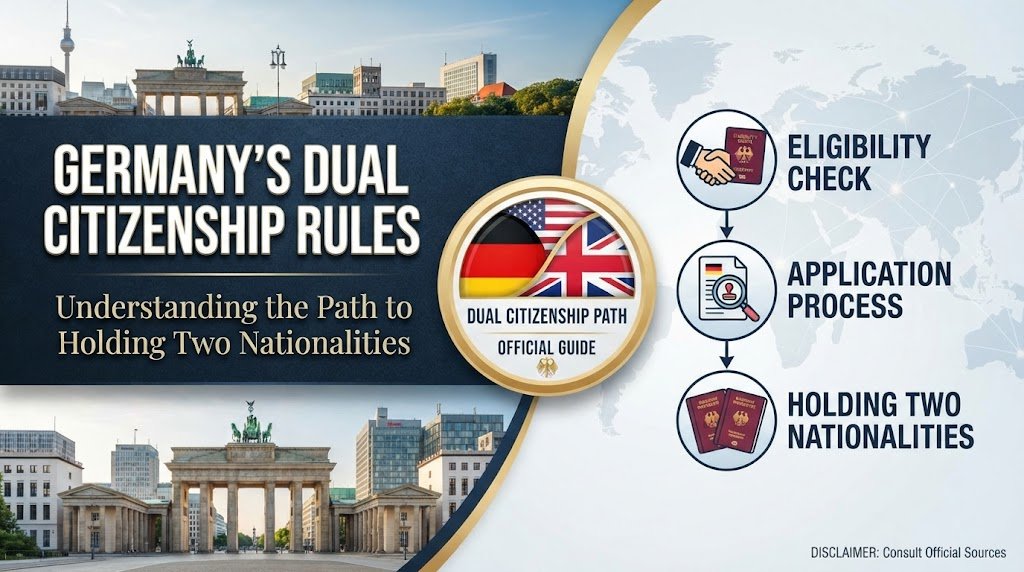
Step 1: Check eligibility
Review your:
- residence history;
- residence permit;
- language qualification;
- financial position;
- criminal-record situation;
- identity documents;
- and other citizenships.
Step 2: Identify the responsible authority
Contact the relevant Staatsangehörigkeitsbehörde in your city or district.
Step 3: Collect documentation
Depending on your circumstances, you may need documents relating to:
- identity;
- birth;
- nationality;
- residence;
- marriage or family relationships;
- employment;
- income;
- German language skills;
- naturalisation-test results;
- and other matters.
Step 4: Submit the application
The application procedure depends on the competent authority. Some authorities offer digital application services, while others use written applications or appointments.
Step 5: Authority review
Officials assess whether the legal requirements have been met.
If additional information or documents are required, the authority may request them.
Step 6: Naturalisation certificate
If the application is approved, naturalisation becomes effective when the applicant receives the naturalisation certificate.
The applicant can then proceed with the relevant German identity and passport documentation.
12. Germany Citizenship Application Costs
Naturalisation is not free.
Current official government information lists the standard naturalisation fee at €255 per person.
For a minor child who is naturalised together with a parent or parents, the fee can be €51 under the applicable rules. Additional costs can arise for documents, translations, certifications and related administrative requirements.
This makes it useful to budget for more than the headline application fee.
Potential additional expenses may include:
- certified copies;
- official translations;
- language examinations;
- naturalisation-test preparation;
- document procurement;
- travel to appointments;
- passport and identity-document fees after naturalisation;
- and professional legal or immigration advice where the applicant chooses to obtain it.
Costs can vary depending on personal circumstances and local administrative requirements.
13. Permanent Residence vs German Citizenship
People sometimes use the terms permanent residence and citizenship interchangeably. They are not the same.
Permanent residence is an immigration status.
Citizenship is nationality.
A permanent resident remains a national of another country while receiving a long-term right to reside in Germany.
A German citizen, by contrast, holds German nationality.
The distinction matters because the two statuses can have different consequences for:
- political participation;
- passports;
- international travel;
- residence rights;
- nationality obligations;
- and certain legal protections.
The official German immigration portal explains that a settlement permit has permanent validity and allows employment, while citizenship is acquired through naturalisation or another recognised route to German nationality.
For someone planning an international relocation, permanent residence may be sufficient for some goals. For another person, citizenship may be relevant because of long-term family, travel or nationality considerations.
The appropriate route depends on individual circumstances.
14. What If Your Original Country Does Not Allow Dual Citizenship?
This is one of the most important questions to answer before applying.
Germany may allow you to retain your original nationality.
Your original country may not.
For that reason, applicants should contact the relevant government authority, embassy or consulate of their existing nationality before assuming that they will permanently hold both nationalities.
Questions worth asking include:
- Does my country permit dual citizenship?
- Do I need to report the acquisition of German citizenship?
- Could I automatically lose my original nationality?
- Are there age restrictions?
- Are there military-service consequences?
- Are there restrictions on using passports?
- Could dual nationality affect inheritance or property rights?
- Do I need to register my second citizenship?
The answer will depend entirely on the law of the other country.
German authorities cannot guarantee that another state will recognise dual nationality.
15. Common Mistakes Applicants Should Avoid
Mistake 1: Relying on outdated three-year information
Many online articles still discuss the three-year accelerated route introduced in 2024.
That information is outdated for the general 2026 framework.
The accelerated three-year route was abolished when the amended law entered into force on 30 October 2025.
Mistake 2: Assuming dual citizenship is automatic
German law permits multiple citizenship, but an applicant still has to qualify for German citizenship.
Mistake 3: Ignoring the original country’s nationality law
Germany allowing dual nationality does not automatically mean your existing country does.
Mistake 4: Confusing permanent residence with citizenship
A settlement permit is not a German passport.
Mistake 5: Waiting until the last minute to obtain language evidence
Applicants should plan their B1 qualification or alternative evidence early.
Mistake 6: Providing incomplete documentation
Missing documents can delay an application.
Mistake 7: Assuming marriage automatically grants citizenship
Marriage can provide a distinct legal route in certain circumstances, but additional requirements still apply.
Mistake 8: Paying unofficial agents for guaranteed citizenship
No private company can legitimately guarantee that the German government will approve a citizenship application.
Be particularly cautious about advertisements promising:
- guaranteed German citizenship;
- guaranteed German passports;
- instant naturalisation;
- citizenship without eligibility requirements;
- or guaranteed approval for a fee.
Official German authorities remain the relevant decision-makers.
16. Is Professional Immigration Advice Necessary?
Not every applicant needs an immigration lawyer.
A straightforward case with clear documentation may be manageable by following the instructions of the responsible nationality authority.
Professional legal advice can nevertheless be useful where the circumstances are complicated.
Examples include:
- previous nationality loss;
- complicated residence history;
- criminal-record questions;
- disputed identity documentation;
- unusual family circumstances;
- previous rejected applications;
- citizenship acquired through descent;
- questions involving multiple nationalities;
- or uncertainty about the legal basis for an application.
Anyone considering paid professional assistance should verify the provider’s qualifications and understand exactly what services are included.
A legitimate adviser should explain the process rather than promise an outcome.
17. Frequently Asked Questions
Can I have dual citizenship in Germany in 2026?
Under German law, yes. Since the 2024 nationality reform, people naturalised as German citizens can generally retain their existing nationality. German citizens can also generally acquire another nationality without losing German citizenship under German law. The other country’s nationality law must still be checked.
How many years do I need to live in Germany before naturalisation?
For the general route, the minimum period is five years of qualifying lawful residence, provided the other legal requirements are satisfied. The former three-year accelerated route was abolished effective 30 October 2025.
Do I need German language skills?
Generally, applicants need German at least at B1 level, although certain German educational qualifications may provide accepted evidence.
Do I have to pass a citizenship test?
Generally, applicants need to demonstrate knowledge of Germany’s legal and social system and way of life, normally through the naturalisation test or an accepted equivalent.
How much does German naturalisation cost?
The standard fee is currently €255 per applicant. A qualifying minor child naturalised together with a parent can be subject to a €51 fee. Additional costs may apply for documents and related services.
Does Germany require me to renounce my old citizenship?
Under current German law, generally no. However, your existing country’s nationality law may have separate requirements.
Can children hold German and another nationality?
Yes, depending on how the nationalities were acquired and the laws involved. Germany no longer generally requires children who acquired multiple nationalities at birth under the relevant rules to choose only one when they become adults.
Does marrying a German citizen automatically give me German citizenship?
No. Marriage does not automatically grant German citizenship. A spouse of a German citizen may qualify under a separate naturalisation route if the applicable residence, marriage-duration and other requirements are satisfied.
18. Final Checklist for Prospective Applicants
If you are considering German citizenship while retaining another nationality, use this checklist as a starting point:
Residence
- Have I completed the required period of qualifying residence?
- Does my current residence status qualify?
- Have I kept accurate records of my residence history?
Language and integration
- Do I have the required German language evidence?
- Have I completed or prepared for the naturalisation test?
- Do I understand the required constitutional declarations?
Financial position
- Can I demonstrate my household income?
- Do I have the documents requested by the authority?
- Have I checked whether any special financial rules apply to my circumstances?
Identity and nationality
- Is my identity properly documented?
- Do I have valid civil-status documents?
- Have I checked whether my current country permits dual citizenship?
Application
- Have I identified the correct nationality authority?
- Have I checked its current application instructions?
- Have I budgeted for the €255 standard naturalisation fee and possible additional expenses?
- Have I avoided anyone promising guaranteed citizenship?
Conclusion
Germany’s approach to multiple citizenship changed substantially with the 2024 nationality reform. Under the current framework, German law generally allows naturalised citizens to retain their previous nationality, removing a major obstacle that previously affected some applicants.
For people considering Germany dual citizenship rules, the most important point is that holding two nationalities involves more than obtaining a German passport. Applicants need to satisfy German naturalisation requirements, including the applicable residence period, language and civic requirements, financial conditions and other legal criteria. They must also determine whether their original country recognises or permits dual nationality.
The five-year general residence requirement is particularly important in 2026. The three-year accelerated naturalisation pathway that existed after the 2024 reform was abolished on 30 October 2025, so applicants should rely on current government information rather than older immigration articles or social-media posts.
Before making financial or relocation decisions, prospective applicants should verify their individual situation with the competent German nationality authority and, where necessary, the government or diplomatic mission of their existing country of nationality.
Official Government Resources
For authoritative information, readers should use:
- Federal Foreign Office — German nationality law and dual citizenship information
- Make it in Germany — official information on naturalisation
- Bundesportal — official government services and naturalisation fees
- Federal Office of Administration — nationality matters for people living abroad
Author Box
Dynamo Gills
Writer & Researcher at Biodynasty
Dynamo Gills writes research-based guides covering international education, immigration, employment, relocation and global career opportunities. Articles are designed to provide practical information while directing readers to official government sources for legal and administrative requirements.
Editorial note: Immigration and nationality laws can change. This article is intended for general informational purposes and should not be treated as individual legal advice. Readers should verify requirements with the relevant German authority before submitting an application or making immigration-related financial decisions.
Official resources for prospective applicants
- Federal Foreign Office — Law on Nationality: Official German nationality law information — covers the current multiple-citizenship framework, five-year naturalisation rule, nationality loss provisions and the responsible authorities.
- Make it in Germany — Naturalisation: Official naturalisation guidance — covers eligibility, B1 German, the naturalisation test, fees and dual citizenship.
- Bundesportal — Naturalisation application: Official German government naturalisation service — useful for official application information and current fees.
- Federal Government — Five-year naturalisation rule: Official explanation of the 2025 naturalisation-law change — confirms that the three-year route ended and five years became the minimum general period.


 Dynamo